
Spa inventory management: deduct supplies per visit, track lots and expiry
Stock never matches and nobody knows why? A practical guide to spa inventory management for spas and aesthetic clinics: usage norms per service, per-visit deduction, expiry-first picking, confirmed transfers and a monthly count.
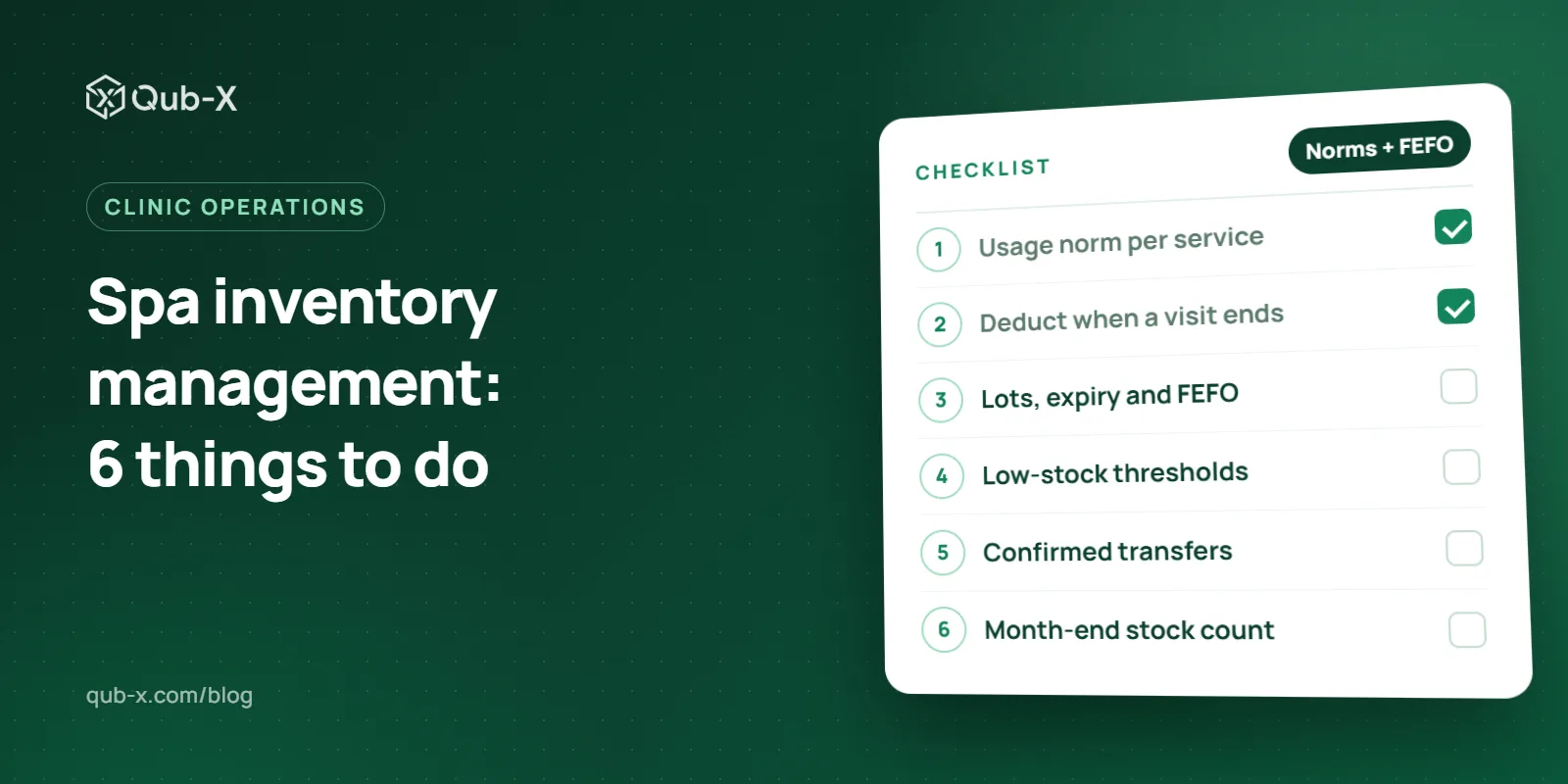
The month-end count comes up three bottles of serum and five boxes of laser tips short, and nobody remembers which visits used them. It is a familiar story at spas and aesthetic clinics, especially once there are two or more branches. When clinic owners see a Qub-X demo, they often ask about exactly this: deducting supplies per treatment, tracking lots and expiry dates, moving stock between branches and getting a warning before something runs out. This article turns their questions into a practical approach to spa inventory management you can start this month.
Why spa stock goes missing for no clear reason
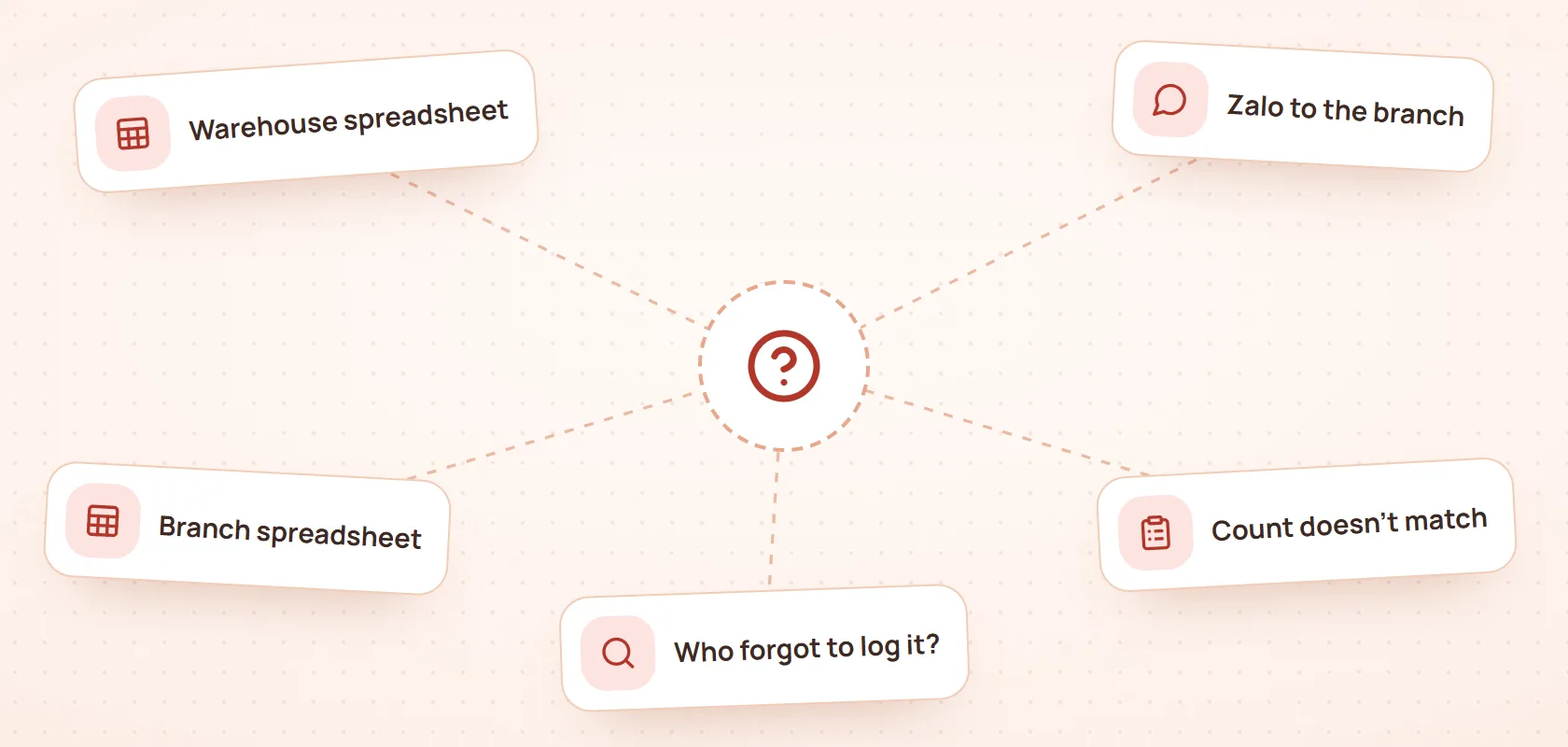
Spa stock rarely goes wrong because of one big mistake. It is usually many small ones adding up:
Supplies used in a visit are never deducted. A therapist takes an extra ampoule or sheet mask and nobody records it.
Each branch keeps its own spreadsheet. The warehouse subtracts in one file, the branch adds in another, and the two never match.
Transfers nobody confirms. Stock sits "in transit" for days and no branch counts it.
Expired stock is thrown away without a write-off. The books still show it; the shelf does not.
Anyone can edit the stock figure. When numbers disagree, people change them to match instead of finding the cause.
To stop the gaps, every movement in, out or between branches has to leave a trace.
What spa inventory management needs to track
Spa inventory management needs six kinds of information:
Information | What it is for |
|---|---|
Stock per branch and central warehouse | Knowing what is left where |
Alert threshold (minimum stock) | Reordering before you run out |
Lots and expiry dates | Using the nearest expiry first |
Usage norm per service | Knowing what one visit uses |
Cost and stock value | Material cost per service |
History of receipts, usage, write-offs, transfers, adjustments | Tracing where a gap began |
Before entering any figures, tidy up two things:
Clear item codes: one name and one code per product, grouped as drugs, consumables or skincare.
One unit per item: choose a unit for each item (bottle, tube, ml, piece) and use it for norms, receiving and counts. If you buy by the case and use by the bottle, write the conversion into your receiving procedure.
Material cost belongs next to your other spa management KPIs, because it comes straight out of profit.
Deduct supplies automatically for every visit
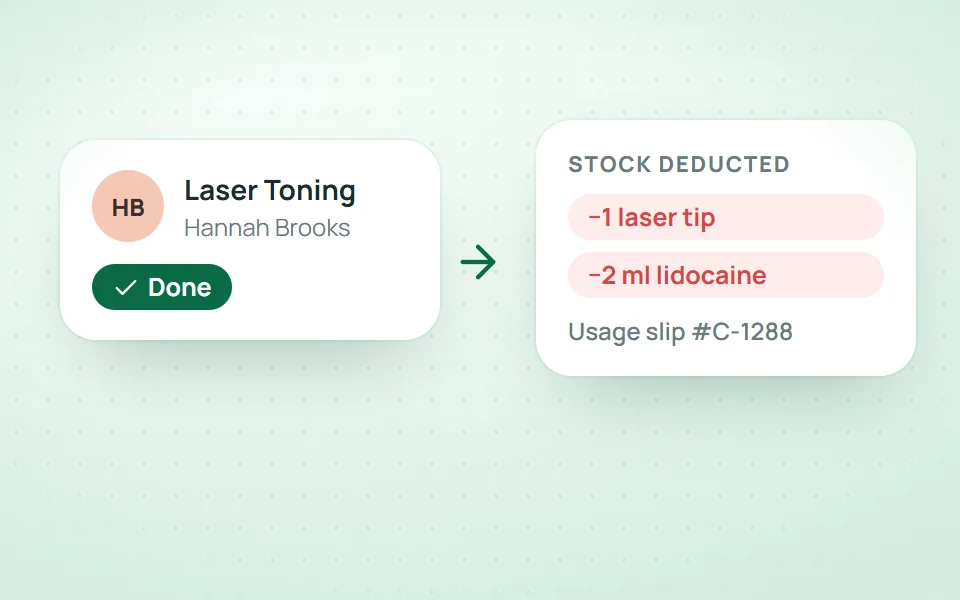
Tying supplies to each visit is the lasting way to keep stock right. Every service needs a usage norm, for example (hypothetical figures):
Service | Supplies for one session |
|---|---|
Basic facial | 3 ml serum, 1 sheet mask, 1 pair of gloves |
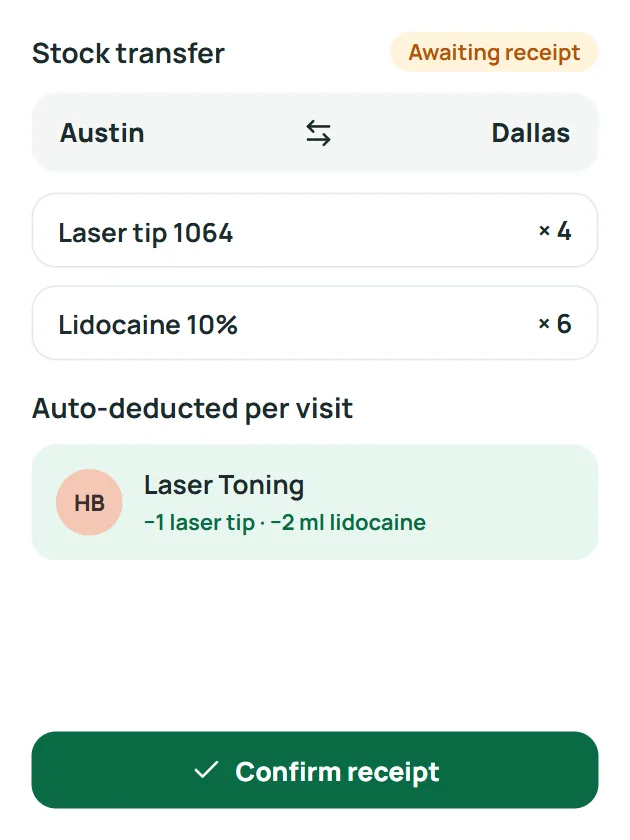
Laser Toning | 1 laser tip, 2 ml lidocaine |
Chemical peel | 2 ml peel solution, 1 pair of gloves |
To set a norm, measure what 5–10 real sessions actually use, take the average and record it in the item's own unit.
In Qub-X, you set the materials for one session of each service once. From then on, every service line marked done on an appointment deducts them from that branch's stock. Usage can be traced back to each booking, and packages can set their own norm per service.
Compare norms with actual usage
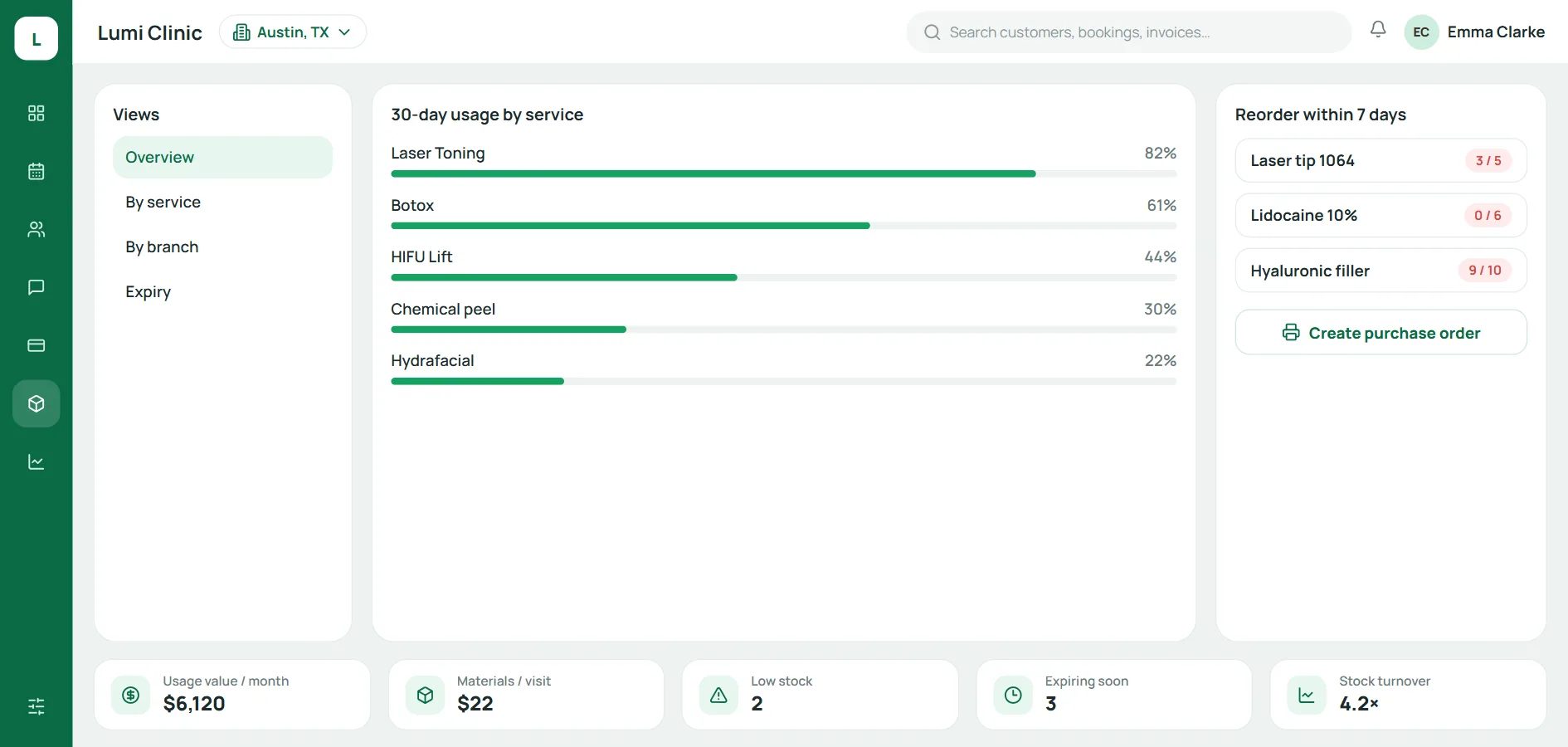
A hypothetical example: a 30 ml bottle of serum and a norm of 3 ml per facial means one bottle covers 10 sessions. A month with 120 facials needs 12 bottles. If the count shows 15 bottles used, 3 bottles are unaccounted for: the norm is too low, therapists use too much, or stock is leaking.
Review the norm or the method for any item with a large gap. Put material cost next to your spa revenue report to see what each service really earns. Qub-X inventory analytics show net usage, shrinkage and days of stock left, along with real material cost per service and per staff member.
Track lots, expiry dates and low-stock alerts
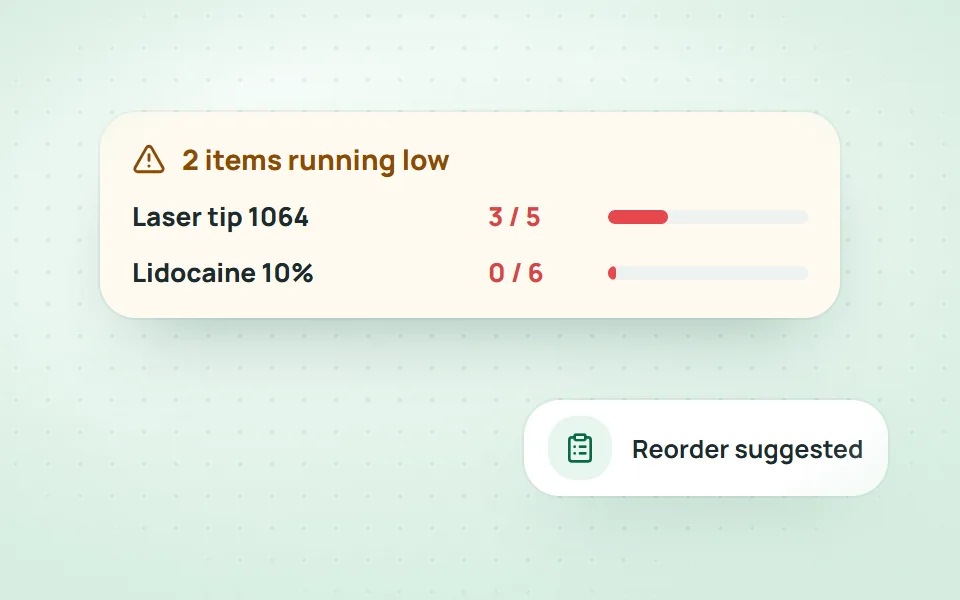
Skincare, drugs and medical supplies all expire, so you need to know which stock expires soon, not just how much is left.
Record the lot and expiry date on receipt. Two lots of the same item can expire on different dates.
Pick by FEFO (first expired, first out): the box that expires sooner is used first, even if it arrived later, and sits at the front of the shelf. For medicines, Annex IV of Circular 36/2018/TT-BYT (in Vietnamese) requires the drug stores of medical facilities to issue batches on a FEFO or first-in, first-out (FIFO) basis.
Take expired stock off the shelf and write it off with a reason.
Set an alert threshold for each item. A hypothetical example: you use 2 boxes a day, the supplier delivers in 5 days and you keep 2 days of buffer, so the threshold is 2 × (5 + 2) = 14 boxes.
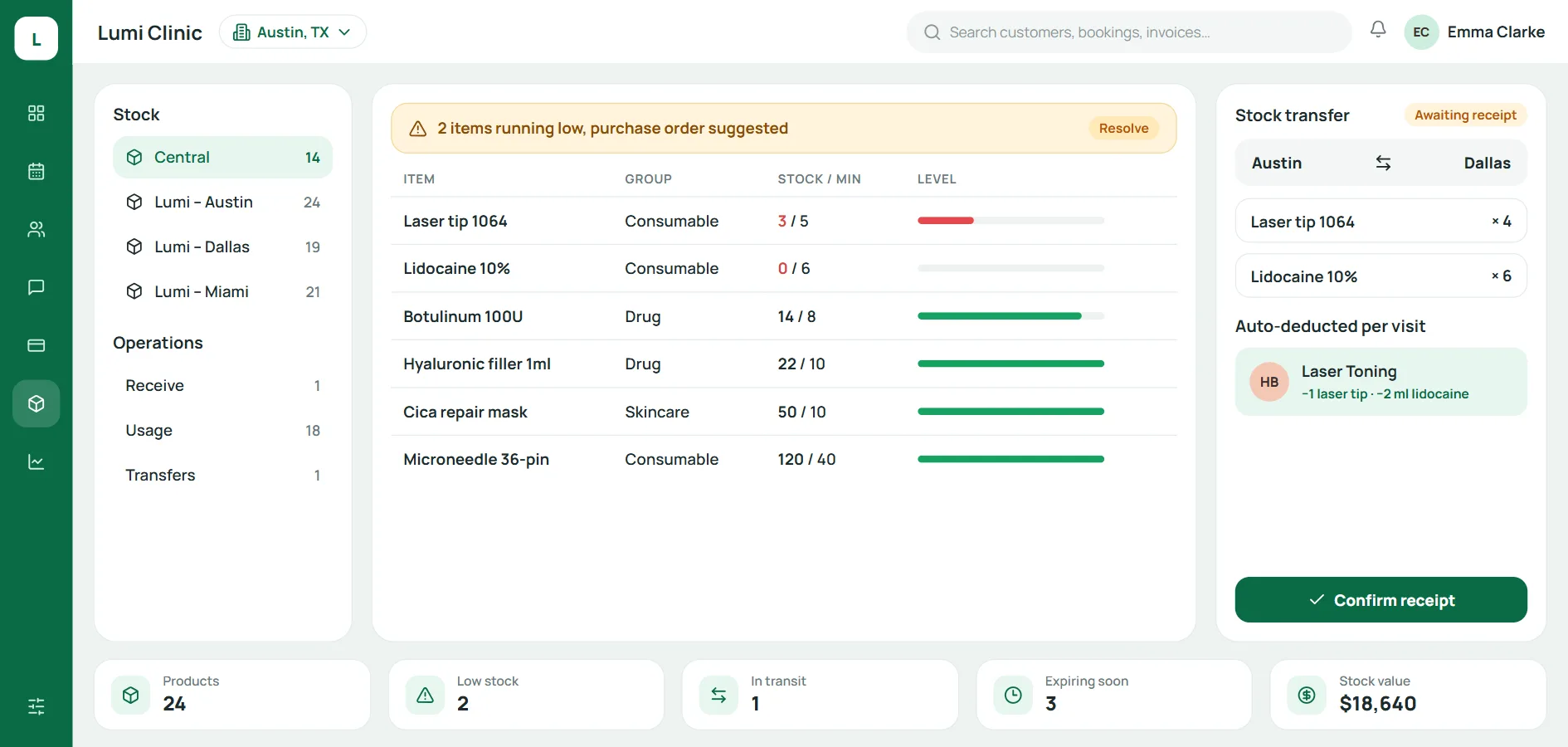
In Qub-X, a receipt records the supplier, quantities, unit cost and expiry on every line, and suppliers and receipts are linked to each lot. The stock table shows the alert threshold and nearest expiry on every row. Items at or below the threshold are tagged LOW, items at zero are tagged OUT, and stock that has expired or expires within 30 days is flagged.
Transfer stock between branches
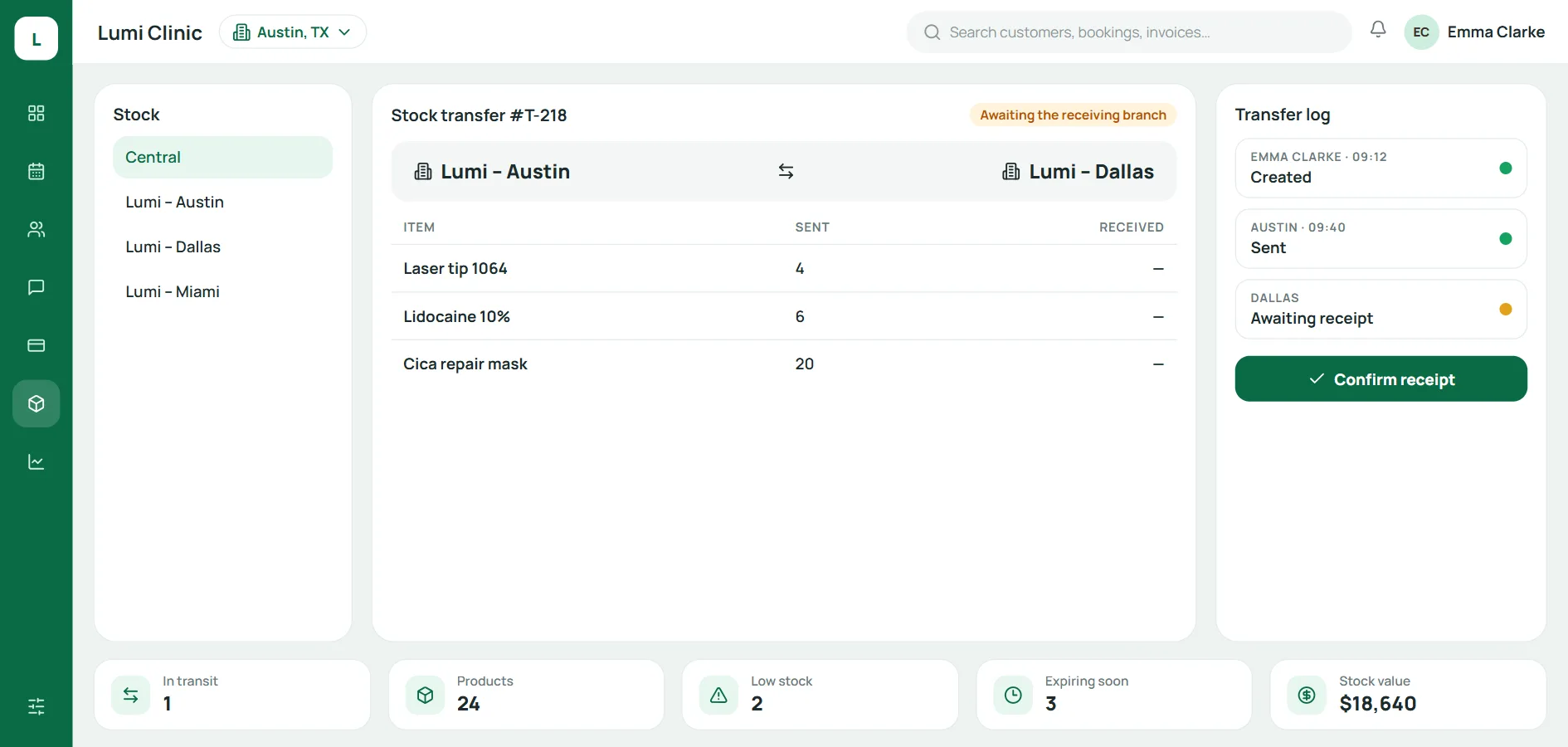
In a multi-branch chain, transfers are where stock most often slips: the sender has subtracted it, the receiver has not added it. Four simple rules:
Every transfer has a slip with the sending branch, the receiving branch, the items and the quantities.
The receiver counts the goods before confirming. Anything missing or broken is noted on the slip.
If a slip is still unconfirmed after a day, a manager follows up.
Stock close to expiry at a slow branch can move to a busier one.
In Qub-X, stock on both sides updates only when the receiving branch clicks Confirm receipt. Slips move from Draft to In transit to Done, unconfirmed batches trigger an alert, and the history records who sent, who received and when.
Monthly stock counts and who can adjust stock
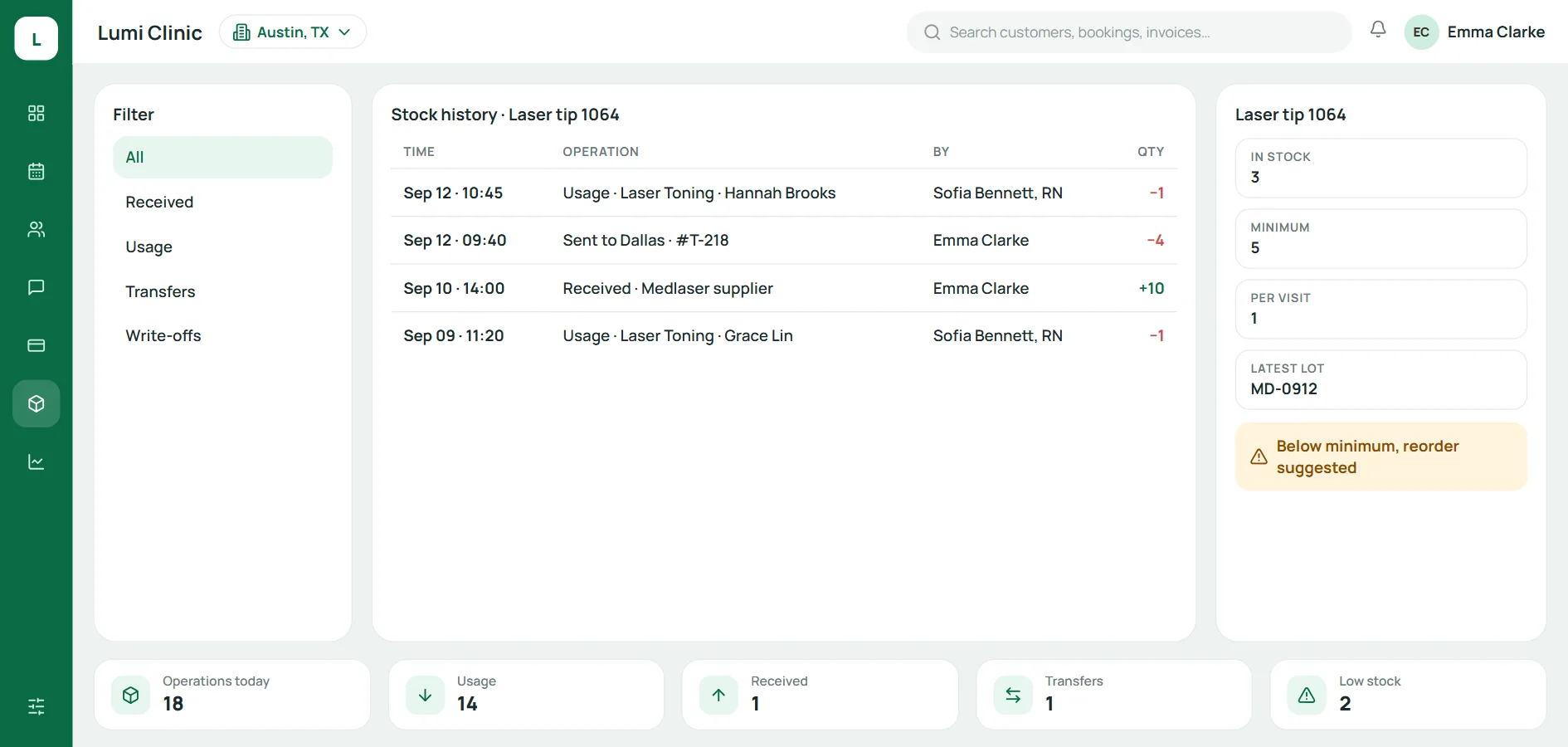
Even with per-visit deduction, you still need a count to catch losses outside the norms. A suggested monthly routine:
Fix a time, for example after the last appointment of the month; no receiving or transfers during the count.
Finish open slips first: unconfirmed transfers and draft receipts.
Count branch by branch in pairs: one person counts, one records.
Compare with the system, and note each gap and its cause per item.
Who can adjust stock? One or two people, usually the stock manager or branch manager, and every adjustment needs a reason. Therapists and front desk staff record usage and receive goods, nothing more.
In Qub-X, the stock ledger records every receipt, issue, manual adjustment or transfer as one row: date, product, quantity, stock before and after, reason and who did it. Manual adjustments are flagged and excluded from net usage. Completed slips can only be reversed, so the original stays, and the ledger exports to Excel for reconciliation with accounting.
How Qub-X supports spa inventory management
Qub-X is management software for spas, aesthetic clinics and dermatology clinics. Its Inventory module puts the central warehouse and every branch on one table:
Supplies are deducted by the norm when a service on an appointment is marked done.
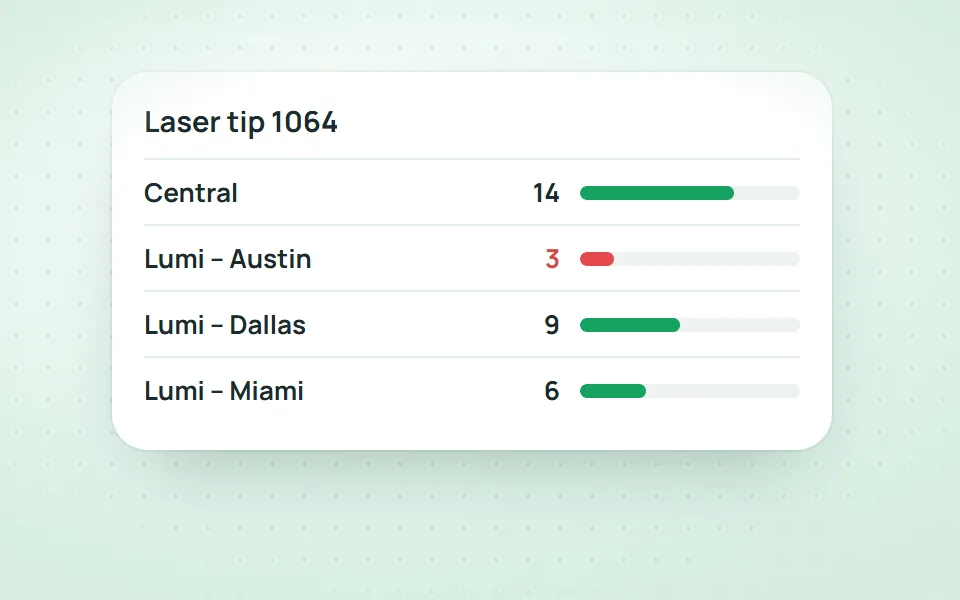
Low-stock alerts by threshold, and flags for stock expired or expiring within 30 days.
Each product page estimates roughly how many days the stock will last, based on the last 30 days of use.
Transfers update stock once the receiver confirms, and every movement goes into the stock ledger.
Receiving slips sync to MISA.
Qub-X runs at an aesthetic clinic chain with 3 branches, about 500 staff and 3,500+ bookings a month. Clinics can try it for 7 days, and the Qub-X team trains staff by role.
Frequently asked questions
How often should a spa count its stock? Do a full count every month at a fixed time. High-value or often-missing items, such as fillers and laser tips, can also be counted weekly.
Is stock deducted for a service without a usage norm? No. Qub-X does not deduct for it; the service page shows No materials yet, and inventory analytics show how many services still need norms.
Can branches see each other's stock? It depends on permissions. By default, each branch sees its own stock and the central warehouse, and managers see everything.
Do manual adjustments distort usage figures? No. Manual adjustments are flagged, saved with a reason and the person who made them, and excluded from net usage.
Conclusion
Spa inventory management does not have to be complicated: a norm for every service, expiry-first picking, confirmed transfers and a count every month. Start with your ten busiest services this month. Book a Qub-X demo to see supplies deducted automatically on your own workflow, or try it for 7 days.
Related articles
All articles on Clinic operations- Clinic operations
Spa time and attendance software: face check-in and automatic shift schedules
Paper timesheets, spreadsheets and leave requests sent by message make closing the month slow. Here is what spa time and attendance software should cover, from face check-in and shifts to multi-branch timesheets, and which Vietnamese rules on hours and personal data apply.
- Clinic operations
Spa treatment packages and prepaid cards: no more session disputes
Disputes over remaining sessions can cost you clients as surely as a disappointing service. Here is how to record, deduct and track spa treatment packages and prepaid cards so the client and the spa always see the same number.
- Clinic operations
How to calculate spa therapist commission: 4 models with examples
Spa therapist commission that is wrong or late can drive good therapists away. Here are 4 commission models, worked examples and how to build a transparent commission statement.