
Spa revenue report: daily, weekly, monthly templates, no manual work
By the time the numbers reach the spa owner, the new month has already begun. Here are daily, weekly and monthly revenue report templates, and how to have the figures ready on their own instead of compiling them by hand at month-end.

A useful spa revenue report has to answer three questions: how much cash did the spa collect today, how much value in services did it deliver, and how many prepaid treatment sessions do customers still have left? These three figures need to be broken down by branch, service and staff member. This article provides daily, weekly and monthly report templates and shows how to have the figures ready automatically, instead of spending two or three days compiling them by hand at the end of every month.
Why is the month-end report always late?
At many spas, reporting is a month-end ritual: the accountant gathers invoices, the front desk counts appointments, branch managers fill in a template, and then someone merges it all into one master sheet. By the time the numbers reach the owner, the new month has started and last month's problems have already had time to happen again.
More worrying than the time is the reliability. Every handoff is a chance for errors: are cancelled appointments counted, when does a prepaid purchase count as revenue, does one branch group its services differently from another? Reports are slow because data is created in many places and in many formats, not because the person preparing the report is slow.
Cash collected is not the value of services delivered
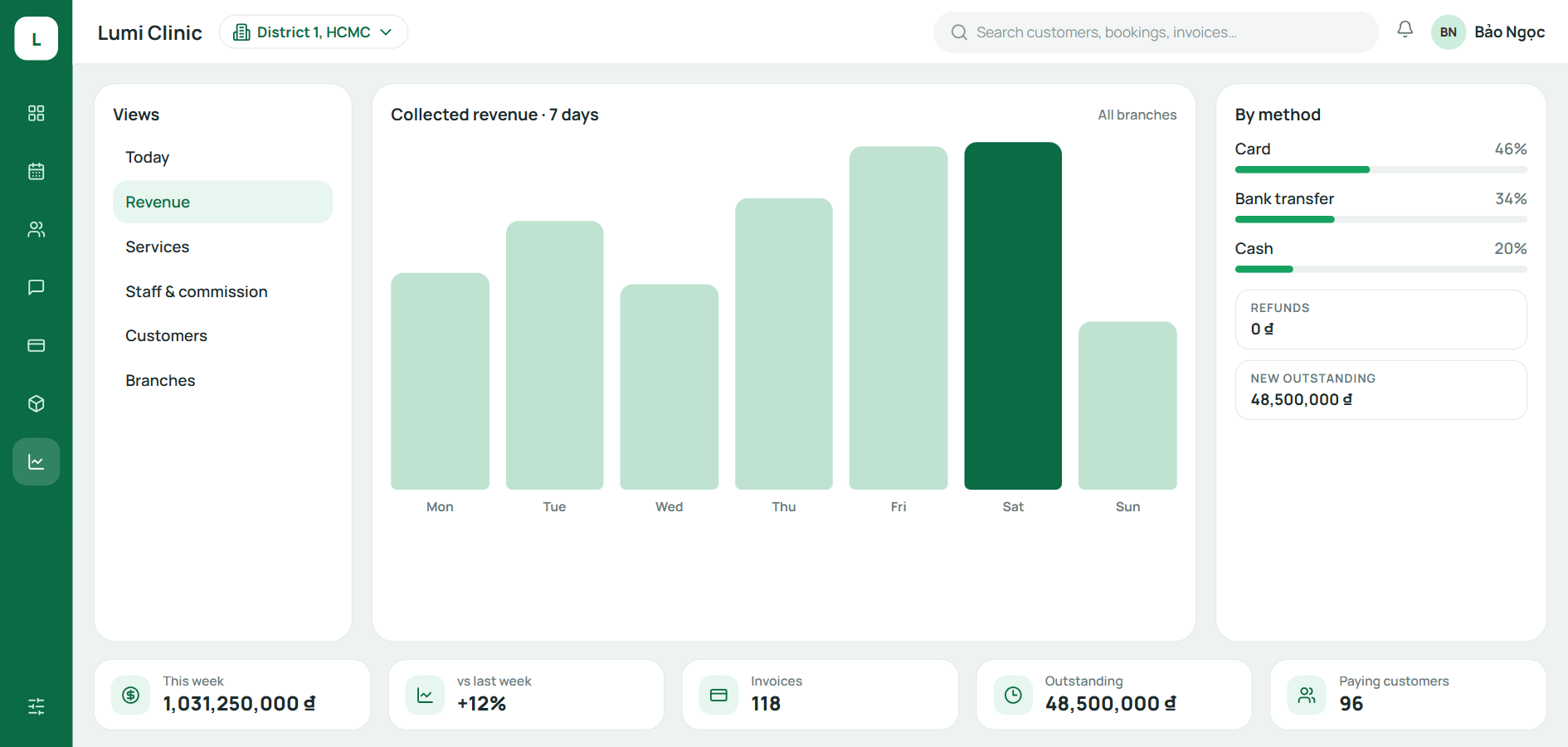
This is where spa revenue reports most often go wrong, because spas sell a lot of prepaid packages. Illustrative example (assumed figures, not industry averages): on 1 June, a customer buys a 10-session package for 10 million VND and pays in full. During June, the customer comes in for 2 sessions.
Figure | June | What it means |
|---|---|---|
Cash collected | 10 million VND | Money that has reached the spa's account |
Value of services delivered | 2 million VND | The services the spa has actually provided |
Treatment sessions still owed | 8 million VND (8 sessions) | What the spa still "owes" the customer |
If you only look at cash collected, June looks great; but the spa still has 8 sessions to deliver over the coming months, with the staff and supply costs that come with them. A management report should show all three figures. How you recognize revenue for accounting and tax purposes should follow your accountant's guidance; the report described here helps you see the real health of your operations.
Spa revenue report templates by day, week and month
Each reporting period answers a different kind of question, so you don't need the same template for all three.
Daily report: for immediate action
Column | What it's for |
|---|---|
Cash collected by payment method (cash, bank transfer, card) | Reconcile the till and the bank account at the end of the day |
Number of visits, cancellations and no-shows | See right away whether today's schedule has a problem |
Invoices not yet paid in full | Collect payment before the customer leaves |
New treatment packages sold | Track cash collected in advance |
Weekly report: for making decisions
Column | What it's for |
|---|---|
Value of services delivered by branch and by service | See which services are driving revenue |
Average revenue per visit | Spot changes in the service mix |
Revenue by staff member | Prepare the figures for commission |
Comparison with the previous 4 weeks | See the trend rather than a single number |
Monthly report: for checking overall health
Column | What it's for |
|---|---|
Cash collected, value of services delivered, treatment sessions still owed | The three figures from the section above |
Customer outstanding balances | Know what still needs to be collected |
Revenue by acquisition channel | Reallocate the advertising budget |
Returning customer rate | Measure the quality of service and aftercare |
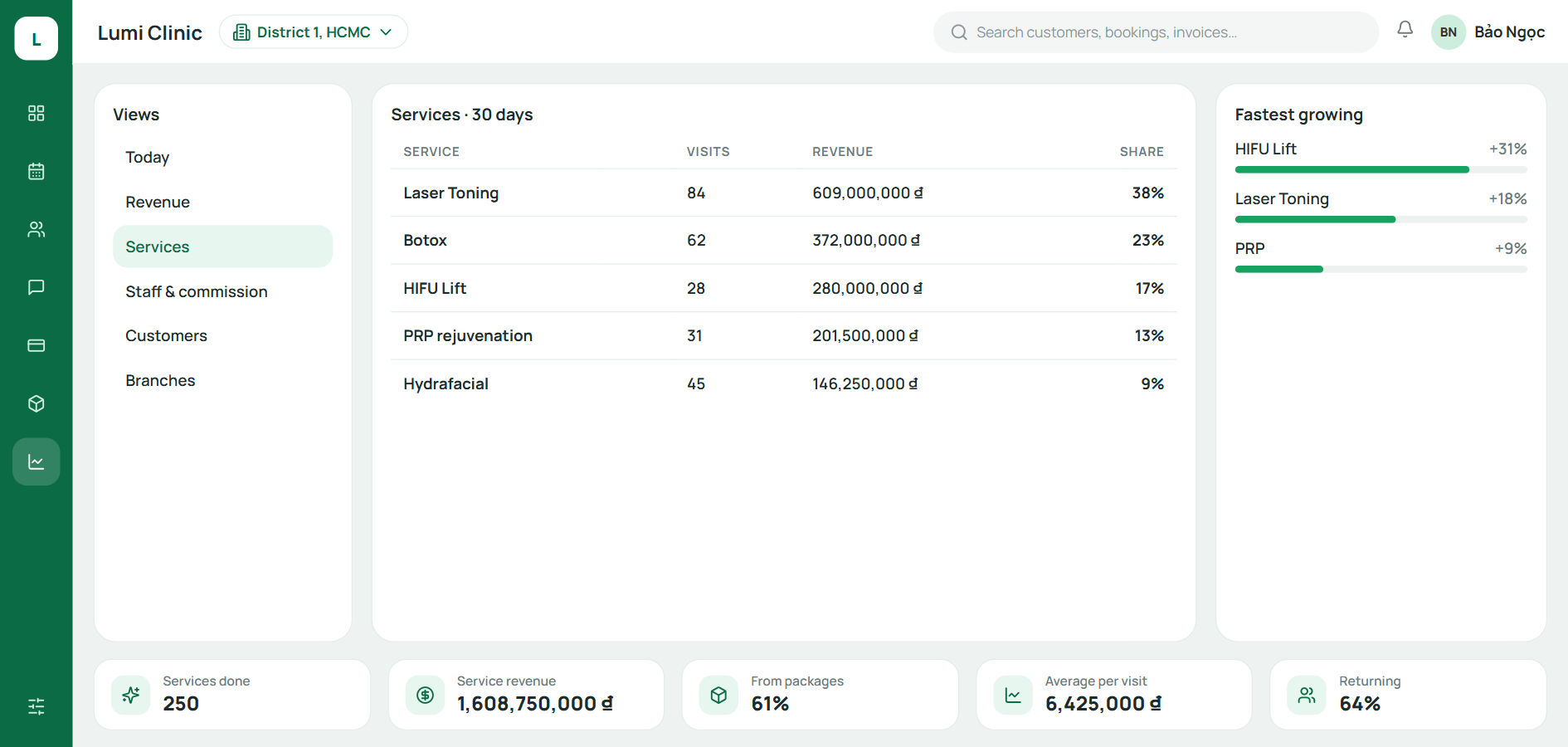
Different views on the same source of numbers
The owner needs to see revenue and trends by branch. The operations manager needs to know how many appointments there are today, who is overloaded and which customers haven't confirmed. The head of the consulting team cares about backlogged conversations and the conversion rate.
One data source can serve all three, as long as each person gets a view that fits the decisions they have to make. A simple rule for choosing each person's figures: if a number doesn't lead to any action this week, it doesn't need to be on that person's daily dashboard.
How do you stop compiling reports by hand?
Reports only become automatic when data is recorded at the right time and in the right place. Check your spa against this list:
Appointments are created, and their status updated (arrived, cancelled, no-show), on one shared calendar.
Every completed service has a treatment sheet linked to the customer and to the staff member who performed it.
Payments are recorded at the counter straight away, linked to the invoice and the treatment package.
The service catalog is the same at every branch, rather than each location naming things its own way.
There is a fixed cut-off time each day for closing the numbers.
Once these five conditions are met, reporting stops being a chore; it simply becomes another view of data you already have. To decide which metrics belong in your weekly meeting, see our article on 7 key spa management KPIs, complete with formulas.
From month-end reports to a weekly meeting rhythm
Once the numbers are ready, a spa can replace the month-end review with 15 minutes at the start of each week: look at two or three notable changes, find the cause and assign someone to follow up. Problems get caught within the week instead of a month later.
If your data is still spread across several places, start with our guide to spa management software to choose the right system. For multi-branch chains, Qub-X is one option that updates the revenue report as soon as the cashier completes a transaction.
Frequently asked questions
Should a spa revenue report be done daily or weekly?
Both, but for different purposes. The daily report is for reconciling cash and handling today's schedule; the weekly report is for making decisions about staffing, services and promotions.
When should prepaid treatment packages count as revenue?
For management reporting, keep the cash collected when a package is sold separate from the value of services as the customer actually uses each session. Recognition for accounting and tax purposes should follow your accountant's guidance.
Is Excel good enough for revenue reporting?
It is when the spa has one branch and only a few prepaid packages. Once you have several branches or many treatment packages, compiling and reconciling the numbers by hand starts to take days, and mistakes creep in easily.
How do you compare revenue fairly between branches?
First, make the service catalog, the way cancellations are counted and the daily cut-off time the same at every branch. Then compare revenue per visit and capacity utilization, not just total revenue.
Related articles
All articles on Reporting & growth- Reporting & growth
7 spa management KPIs: formulas and how to read each one
Seven lean KPIs with clear formulas that help spa owners spot problems within the week instead of at month-end, from message response speed to customer return rate.
- Electronic medical records
EMR for Aesthetic Clinics: Which Facilities Must Implement by December 31, 2026, and How to Prepare
Under Circular 13/2025/TT-BYT, aesthetic and dermatology clinics licensed to provide medical examination and treatment must complete the implementation of electronic medical records by December 31, 2026. This article summarizes which facilities are in scope, what to prepare, and how Qub-X is building its EMR feature.
- Staff & commission
Spa customer records: bring scattered customer data into one place
When consultation notes live in chat, treatment history in a notebook and payments in a spreadsheet, a spa loses more than search time. What should a customer record hold, and how do you bring it all into one place?