
7 spa management KPIs: formulas and how to read each one
Seven lean KPIs with clear formulas that help spa owners spot problems within the week instead of at month-end, from message response speed to customer return rate.
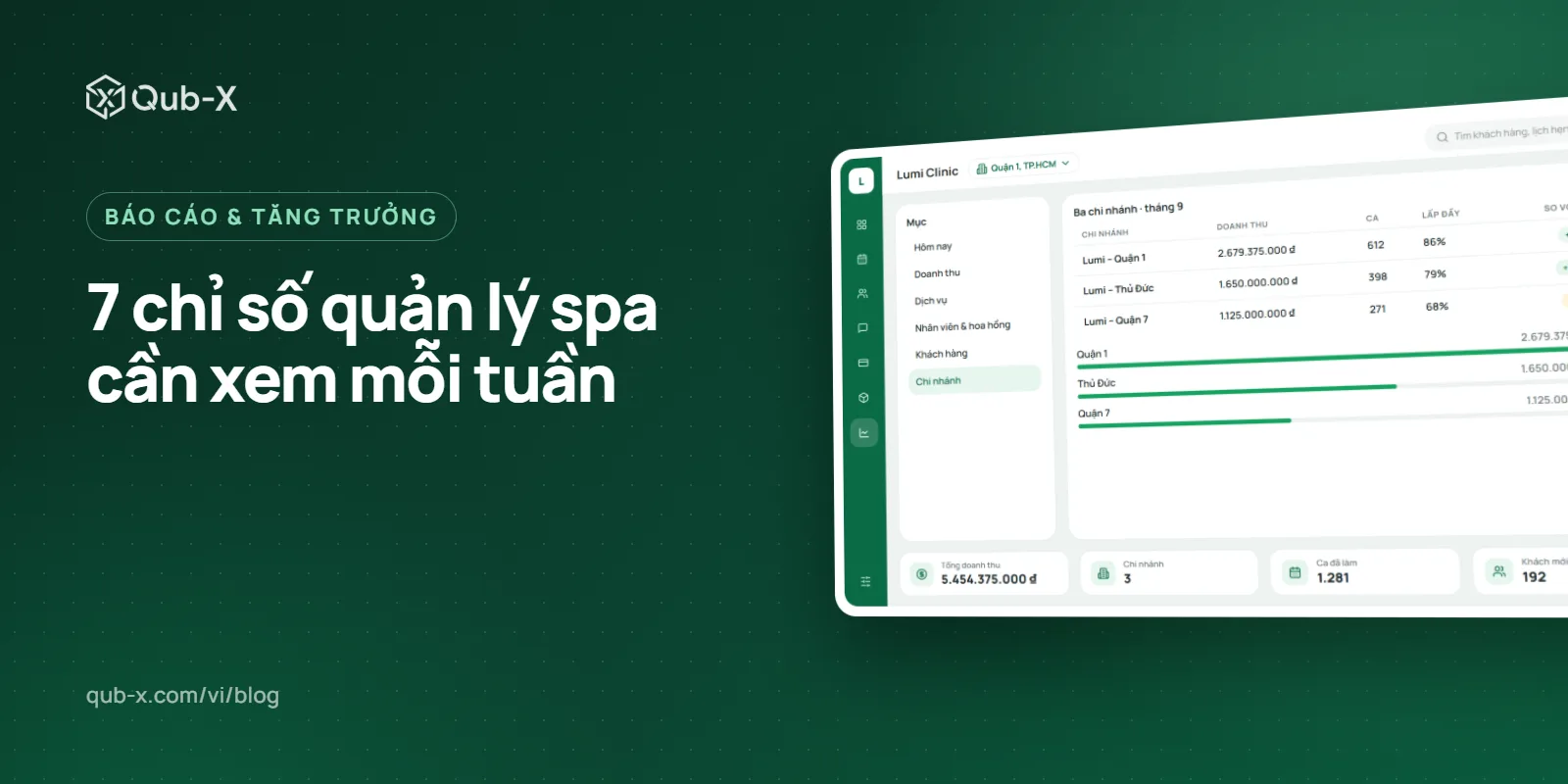
The seven spa management KPIs worth tracking every week are: on-time response rate, consultation-to-booking conversion rate, show-up rate, schedule utilization, average revenue per visit, customer return rate, and remaining treatment packages and outstanding balances by branch. This article gives you the formula for each KPI, a worked numerical example and a way to turn the numbers into concrete actions for the week.
Why track only 7 KPIs?
A report is only useful if it helps managers spot problems and act on them. A dashboard with thirty numbers usually goes unread, and the changes that really matter get buried among figures that never lead to a decision.
The seven KPIs below follow the customer journey step by step: the customer messages you, gets a consultation, books an appointment, arrives at the spa, receives the service, pays and comes back. When one KPI drops, you know straight away which stage of the journey the problem sits in.
Formula table for the 7 spa management KPIs
What matters most is not the number but the definition. If two branches calculate the same KPI in two different ways, you cannot compare them. Agree on the table below before you start measuring.
# | KPI | Formula | Question it answers |
|---|---|---|---|
1 | On-time response rate | New messages answered within the target time ÷ total new messages | Are customers left hanging right after they ask a question? |
2 | Consultation conversion rate | Consultation conversations that led to an appointment ÷ total consultation conversations | Are consultations turning into bookings? |
3 | Show-up rate | Appointments where the customer arrived ÷ total appointments booked in the period | Are bookings turning into actual visits? |
4 | Schedule utilization | Service hours delivered ÷ therapists' available working hours | Are your staff and rooms being fully used? |
5 | Average revenue per visit | Value of services delivered ÷ number of customer visits | How much does each visit bring in? |
6 | Customer return rate | Customers who returned within N days ÷ customers who visited during the base period | Do customers want to come back? |
7 | Remaining treatment packages and outstanding balances | Total sessions sold but not yet delivered, and total amount customers still owe, by branch | How many sessions does the spa "owe" its customers, and how much do customers owe the spa? |
For KPI 6, choose N based on your main service cycle. A spa offering regular skincare might choose 60 days; a clinic with long treatment courses might choose 90 days.
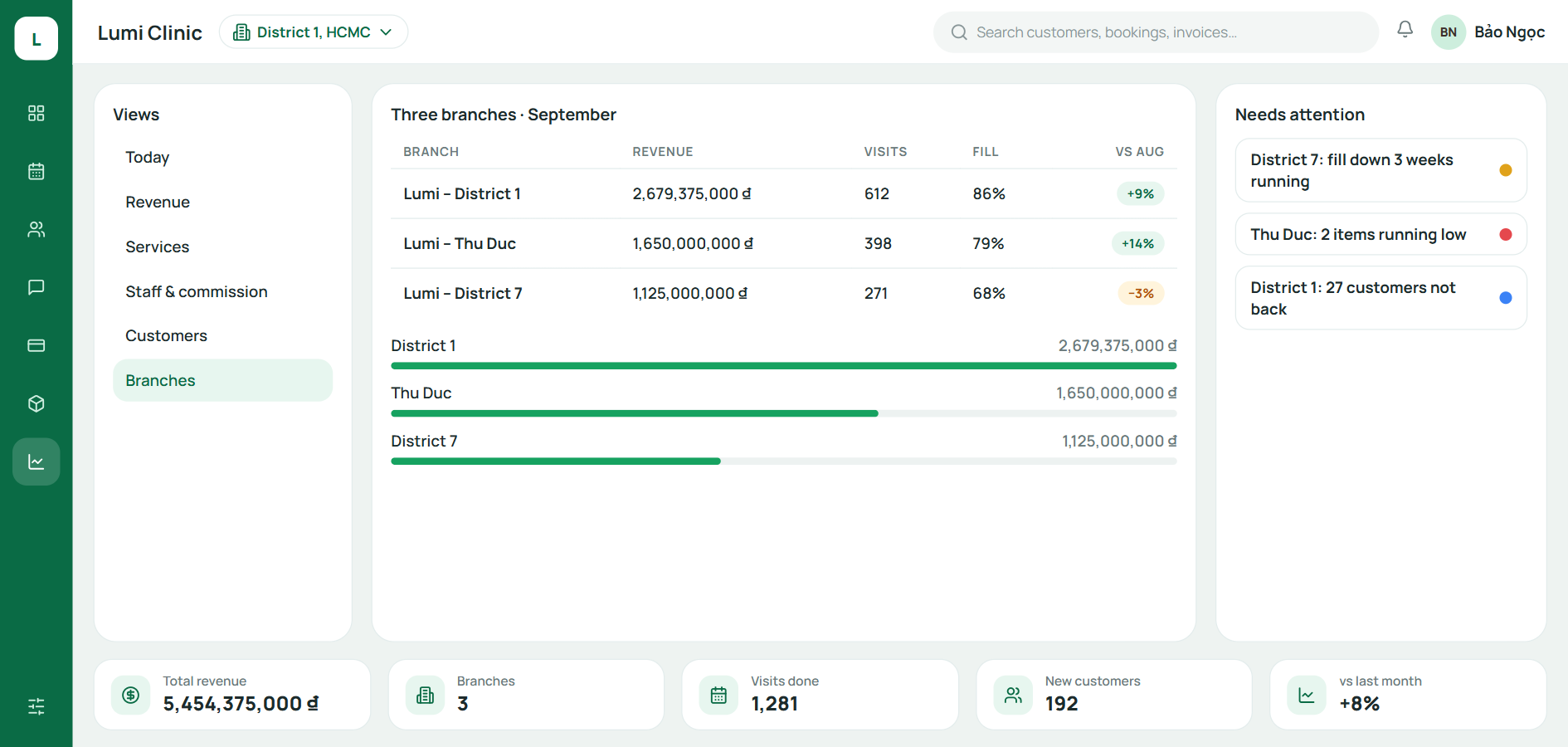
Example: calculating the 7 KPIs for one branch over one week
The figures below are illustrative figures, not industry averages. They are only here to show how each calculation works.
KPI | Data for the week | Result |
|---|---|---|
On-time response (target: 15 minutes) | 102 of 120 new messages answered within 15 minutes | 85% |
Consultation conversion | 42 appointments from 120 consultation conversations | 35% |
Show-up | 136 visits from 160 booked appointments | 85% |
Schedule utilization | 150 service hours out of 192 available hours (4 therapists × 6 days × 8 hours) | 78% |
Revenue per visit | 204 million VND in service value ÷ 136 visits | 1.5 million VND |
Return within 60 days | 135 of 300 customers who visited during the base period | 45% |
Remaining packages and balances | 640 sessions sold but not yet delivered; 38 million VND still owed by customers | Track the trend |
Looking at this table, a manager can start asking questions right away. Were the 24 appointments that didn't turn into visits cancellations or no-shows? At 78% utilization, which time slots do the 42 empty hours fall into? Each question leads to a specific task for the week.
How to read each KPI and what to do when it drops
1. On-Time response rate drops
This usually happens because messages pile up at peak hours or because no one has clear ownership of each channel. Look at which time slots and which channels the late replies fall into. Our article on how a multichannel inbox reduces missed customers explains how to assign ownership.
2. Consultation conversion rate drops
Compare your consultants before drawing any conclusions. If only one person's rate has dropped, it is a skills issue; if everyone's has dropped, review the quality of leads coming from a new ad channel or any recent price changes.
3. Show-Up rate drops
Separate customers who cancelled in advance from no-shows who didn't let you know. No-shows usually fall when the spa sends a reminder the day before and reconfirms on the morning of the appointment.
4. Schedule utilization is low
Look at where the empty hours cluster. If they fall at the start of the week or around midday, you could design an offer for those time slots instead of discounting across the board.
5. Revenue per visit drops
Check your service mix. Are customers switching to cheaper services, or are therapists recommending suitable add-on services less often?
6. Customer return rate drops
This is the earliest warning sign for the quality of your service and aftercare. Call a group of customers who didn't come back to find out their real reasons.
7. Remaining treatment sessions grow quickly
When the number of sessions sold but not yet delivered rises fast, the spa is collecting money upfront faster than it can serve customers. Check this against your schedule utilization so customers don't end up buying a package and then being unable to book a slot.
Setting alert thresholds: compare against yourself first
There is no "industry standard" figure that works for every spa, because pricing, services and customer bases vary too much. A more practical approach is to use your branch's own average over the last 8 weeks as the baseline, then trigger an alert when a KPI moves away from that baseline by more than a margin you choose, for example 10%.
Only compare branches once your definitions are aligned: the same way of counting cancellations, the same target response time and the same cut-off time for closing the numbers. Otherwise, you will be comparing two figures that look alike but measure two different things.
A 15-minute weekly meeting built on the 7 KPIs
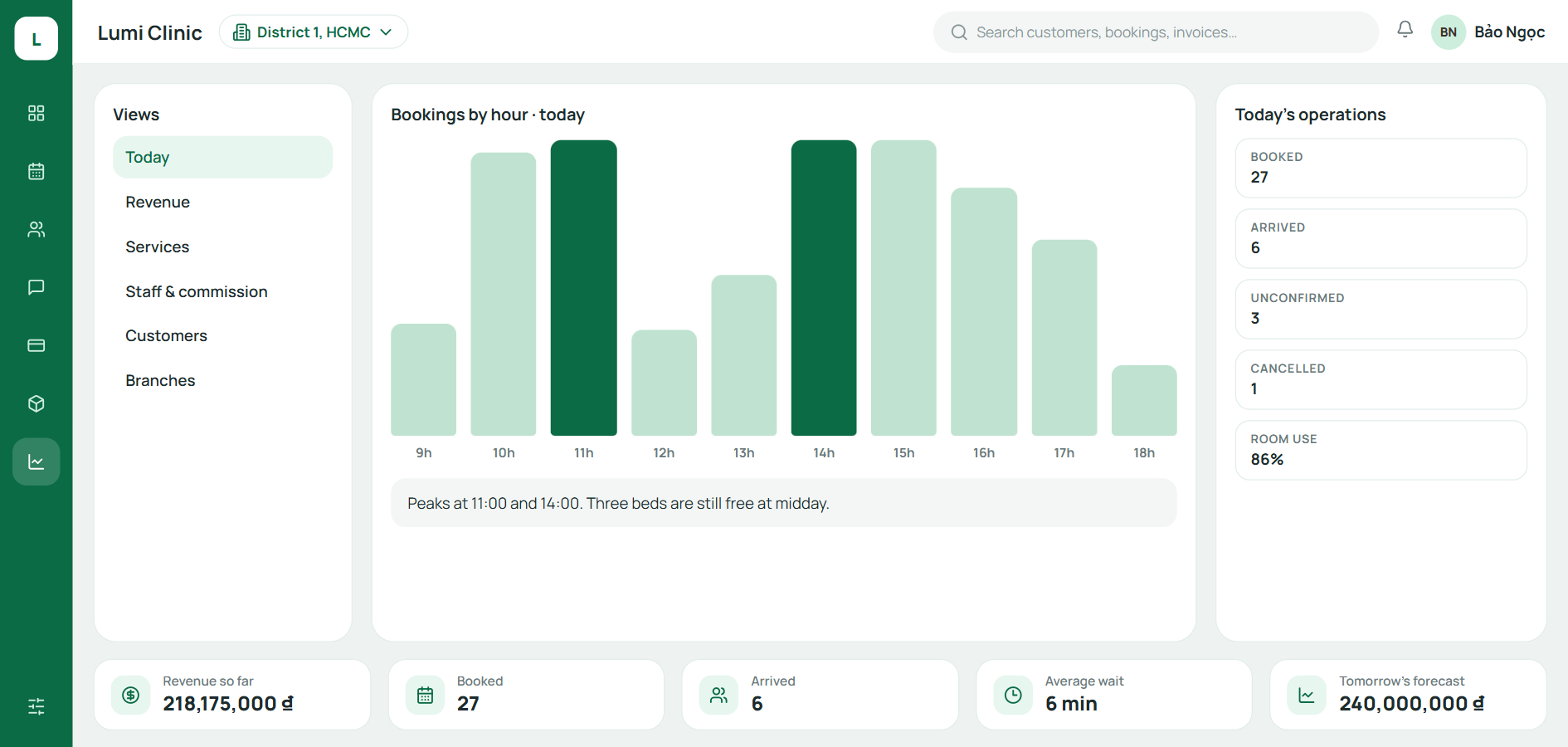
A short, regular meeting is worth more than a thick report at the end of the month. Here is a suggested running order:
3 minutes: scan the 7 KPIs and flag any that have crossed an alert threshold.
7 minutes: pick no more than two of the most notable changes and find the cause.
5 minutes: assign an owner and a follow-up date for each action.
To have the numbers ready before the meeting without compiling them by hand, see our article on the spa revenue report, which covers how to capture data right at the source.
When appointments, conversations and payments all live in one system such as Qub-X, these 7 KPIs are calculated automatically for each branch instead of being pieced together from multiple files.
Frequently asked questions
What is a good customer return rate?
There is no reliable universal figure for every spa. Use your own rate over the last 8 weeks as the baseline and aim to improve on it gradually.
Do cancellations count toward the No-Show rate?
Keep the two groups separate: customers who cancel in advance and customers who don't show up without giving notice. The two groups have different causes and call for different responses, and lumping them together hides the problem.
Does a Single-Branch spa need all 7 KPIs?
You can start with 4: on-time response, consultation conversion, show-up and customer return. Add schedule utilization and remaining treatment sessions once the spa is selling a lot of prepaid packages.
Should i review KPIs daily or weekly?
Weekly for decisions, and daily only for urgent operational tasks such as message backlogs and unconfirmed appointments. Daily figures fluctuate a lot and can push you into reacting to random swings.
Related articles
All articles on Reporting & growth- Reporting & growth
Spa revenue report: daily, weekly, monthly templates, no manual work
By the time the numbers reach the spa owner, the new month has already begun. Here are daily, weekly and monthly revenue report templates, and how to have the figures ready on their own instead of compiling them by hand at month-end.
- Electronic medical records
EMR for Aesthetic Clinics: Which Facilities Must Implement by December 31, 2026, and How to Prepare
Under Circular 13/2025/TT-BYT, aesthetic and dermatology clinics licensed to provide medical examination and treatment must complete the implementation of electronic medical records by December 31, 2026. This article summarizes which facilities are in scope, what to prepare, and how Qub-X is building its EMR feature.
- Staff & commission
Spa customer records: bring scattered customer data into one place
When consultation notes live in chat, treatment history in a notebook and payments in a spreadsheet, a spa loses more than search time. What should a customer record hold, and how do you bring it all into one place?