
Aesthetic clinic regulations 2026: 6 areas you must get right
2026 brings many new legal documents for aesthetic and dermatology clinics: electronic medical records, electronic prescriptions, personal data, a new penalty decree and advertising rules. Here is a summary of the key dates and a compliance checklist.

In this article · 10 sections
In 2026, aesthetic clinic regulations change in six areas: licensing and scope of services, electronic medical records (deadline 31 December 2026), electronic prescriptions (mandatory for clinics from 1 January 2026), personal data protection (new law from 1 January 2026), record retention, and advertising that uses customer images. On top of these come two new penalty decrees that replace the older documents. This article summarizes the key dates, the main obligations in each area, and a checklist clinics can use to review their own compliance.
Key dates: aesthetic clinic regulations 2026
Document | Main content | Date | Notes |
|---|---|---|---|
Invasive cosmetic services may only be performed at hospitals and clinics | 1 January 2024 | Spas may not perform them | |
Electronic prescriptions | Clinics: before 1 January 2026 | Deadline has passed | |
Health data is sensitive data | 1 January 2026 | Decree 13/2023 no longer in effect | |
Ads for medical examination and treatment must state the license number and professional scope | 15 February 2026 | ||
Invasive cosmetic services need a certificate of eligibility for security and order | 15 March 2026 | In addition to the medical examination and treatment license | |
Penalties for violations in the health sector | 15 May 2026 | Replaces Decree 117/2020 | |
Penalties for personal data protection violations | 19 August 2026 | ||
Electronic medical records | 31 December 2026 | Hospitals stop using paper medical records from 1 January 2027 |
1. Licensing and scope of services: how is a spa different from a clinic?
Under Decree 96/2023/ND-CP (Article 40, Clause 12), a facility that provides cosmetic services intervening in the human body, including surgery, procedures, injecting, pricking, filling, light beams, waves, burning or other invasive interventions, must be set up as a hospital, a general clinic or a specialist clinic. This rule also applies to tattooing, permanent makeup and microblading on the skin (xăm, phun, thêu) that use injectable anesthetics.
A point that is often overlooked: the list is not limited to needles. Services that use light beams, waves or burning are also on the list of invasive interventions, so spas should carefully review the machines they currently use.
Under Decree 90/2026/ND-CP, providing these services at a facility that is not licensed can be fined VND 40–50 million for individuals, and double that for organizations, together with a suspension of operations for 12–24 months. Beyond the medical examination and treatment license, from 15 March 2026 facilities that provide invasive cosmetic services also need a certificate of eligibility for security and order under Decree 58/2026/ND-CP (Ministry of Public Security).
Many articles online still cite Decree 117/2020/ND-CP. That decree ceased to have effect on 15 May 2026.
2. Electronic medical records: deadline 31 December 2026
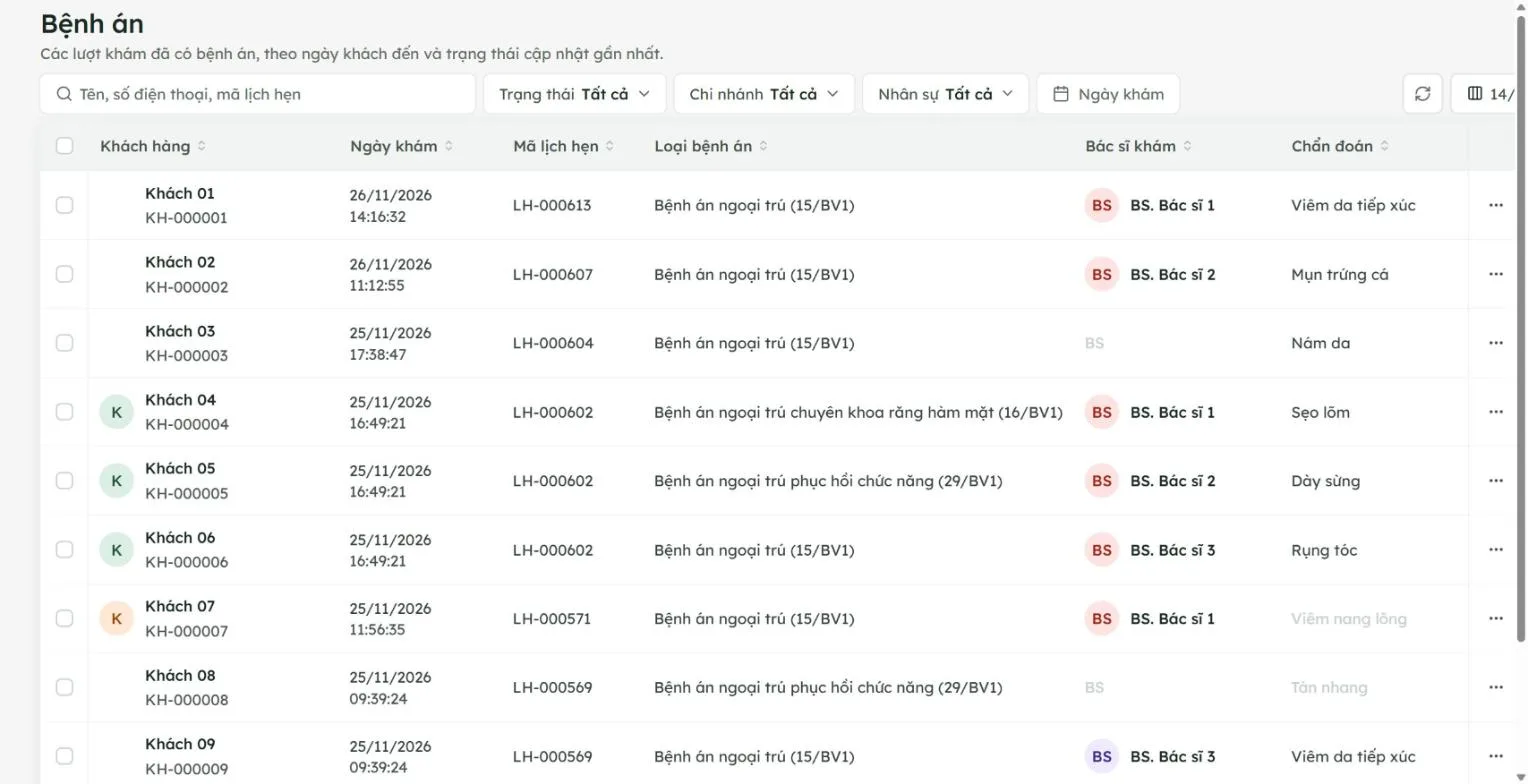
Every clinic with a medical examination and treatment license, whatever its size or specialty, must complete its electronic medical record rollout by 31 December 2026 at the latest, under Circular 13/2025/TT-BYT. Records must be signed or confirmed electronically and linked to the patient's personal identification number, and the clinic must issue its own regulations on managing electronic medical records.
Details on who is covered, the infrastructure requirements and the 6 steps to prepare are in our article on EMR for aesthetic clinics.
3. Electronic prescriptions: required for clinics since 1 January 2026
Circular 26/2025/TT-BYT requires medical examination and treatment facilities other than hospitals to issue prescriptions electronically before 1 January 2026. For aesthetic and dermatology clinics that prescribe medicines, this is an obligation that already applies, not something they are still preparing for.
Key points of Circular 26/2025:
Electronic prescriptions have the same legal validity as paper prescriptions (Article 10).
Clinics must send electronic prescriptions to the National Prescription System as soon as the medical examination and treatment process ends (Article 12).
Clinics send the electronic prescription or the prescription code to the patient by electronic means.
Prescriptions show the patient's personal identification number, ID card number or passport number, if available (Article 6).
4. Personal data protection: health data is sensitive data
From 1 January 2026, the Law on Personal Data Protection and Decree 356/2025/ND-CP classify health condition and biometric data as sensitive data. Clinics must obtain customer consent for each purpose and keep evidence of that consent. Because they directly process sensitive data, they usually do not qualify for the exemption for small businesses: they must prepare an impact assessment dossier within 60 days and appoint a person in charge of data protection.
The specific fines under Decree 330/2026/ND-CP and a checklist of 10 things to do are in our article on customer data security at aesthetic clinics.
5. Record retention: 10 years, and 20 years for cosmetic surgery
Under the Law on Medical Examination and Treatment 2023 (Article 69), paper and electronic medical records have the same legal validity and must be stored and kept confidential. Patients have the right to read and copy their records and to receive a summary when they request it in writing. Retention periods are set by Circular 33/2025/TT-BYT:
Type of record | Retention period |
|---|---|
Inpatient and outpatient medical records | 10 years |
Medical records for cosmetic surgery treatment | 20 years |
Records of medical incident resolution | Permanent |
Logbooks used for medical examination and treatment | 5 years |
When choosing software, ask clearly where the data is stored, how it is backed up and whether it can be exported, because the clinic is responsible for keeping records for the full retention period, even if it changes vendors.
6. Advertising and customer images
Four rules to remember when advertising cosmetic services:
Consent of the person in the image: under the Civil Code 2015 (Article 32), using an individual's image requires that person's consent, and using it for commercial purposes requires paying them, unless the parties agree otherwise. The Advertising Law (Article 8) prohibits advertising that uses an individual's image without that person's consent.
Mandatory information: under Decree 342/2025/ND-CP, ads for medical examination and treatment services must state the name, address, operating license number, working hours and the approved scope of professional activities.
Stay within scope: the Law on Medical Examination and Treatment prohibits advertising that goes beyond the approved scope of practice or scope of professional activities, as well as misleading advertising.
Personal data: customer photos are personal data; publishing them without consent can be fined under Decree 330/2026/ND-CP.
None of the documents above has a specific provision on before-and-after treatment photos. The main constraints are the customer's consent, not advertising falsely or beyond your professional scope, and the rules on personal data. The advertising policy of each social media platform may be stricter than the law.
Compliance checklist for aesthetic clinics
The services you provide fall within your approved professional scope.
You hold a certificate of eligibility for security and order if you provide invasive cosmetic services.
You issue electronic prescriptions and are connected to the National Prescription System.
You have a plan to complete electronic medical records by 31 December 2026, together with internal regulations.
Your storage and backup plan covers 10 years, and 20 years for cosmetic surgery records.
Your data processing consent forms are separated by purpose, and you keep evidence of consent.
You have prepared an impact assessment dossier and appointed a person in charge of data protection.
Access to customer data is assigned by role, with activity logs.
You obtain separate consent and agree on payment before using customer photos in advertising.
Every ad states your operating license number and professional scope.
Many items on the checklist need a shared records management system, clear permissions and the ability to keep a history. The internal process for each step is in our article on the aesthetic clinic operations process. Qub-X already offers electronic medical records under Circular 13/2025/TT-BYT and the national e-prescription link in its Accelerate and Customizing plans, helping clinics meet the 31 December 2026 deadline.
Frequently asked questions
Can spas inject fillers or Botox?
No. Under Decree 96/2023/ND-CP, cosmetic services that involve injecting, pricking, filling or other invasive interventions may only be provided at hospitals, general clinics or specialist clinics. Violations can lead to fines and suspension of operations under Decree 90/2026/ND-CP.
Do aesthetic clinics have to use electronic prescriptions?
Yes, if the clinic prescribes medicines. Under Circular 26/2025/TT-BYT, medical examination and treatment facilities other than hospitals must issue electronic prescriptions before 1 January 2026 and send them to the National Prescription System.
Is Decree 117/2020/ND-CP still in effect?
No. From 15 May 2026, Decree 90/2026/ND-CP replaced Decree 117/2020/ND-CP on administrative penalties in the health sector.
How long must cosmetic surgery medical records be kept?
20 years under Circular 33/2025/TT-BYT. Standard inpatient and outpatient medical records are kept for 10 years.
Are small clinics exempt from personal data protection obligations?
Usually not. The exemption for small businesses and household businesses only covers preparing an impact assessment dossier and appointing a person in charge, and it does not apply when a facility directly processes sensitive data such as health information.
Sources
Circular 26/2025/TT-BYT on prescriptions (official PDF) (in Vietnamese)
National Prescription System (in Vietnamese)
Decree 356/2025/ND-CP (Official Gazette) (in Vietnamese)
Decree 330/2026/ND-CP (Official Gazette) (in Vietnamese)
Civil Code 2015 (Official Gazette) (in Vietnamese)
This article summarizes documents issued up to October 2026. It is for reference only and does not replace legal advice. Clinics should check the original documents and the guidance of their local Department of Health.
This article was written with AI assistance and reviewed by Harry.
Related articles
All articles on Regulations & EMR- Regulations & EMR
Aesthetic Treatment Consent Form: 8 Sections and How to Store It
A treatment consent form for aesthetic services needs 8 sections: client details, service, health, risks, expected results, aftercare, photos and signatures. Includes a table of common mistakes.
- Regulations & EMR
CRM vs EMR: What Is the Difference and Which Does an Aesthetic Clinic Need?
CRM manages customer relationships; an EMR records treatment. Here is a 6-point comparison and 3 questions to ask vendors before you choose software for an aesthetic clinic.
- Regulations & EMR
E-prescribing in Vietnam: what clinics need to know about the National Prescription System
Since 1 January 2026, clinics in Vietnam must use e-prescribing, and some provincial Departments of Health are checking that prescriptions reach the national system. What aesthetic and dermatology clinics need to know about Circular 26/2025/TT-BYT, connection codes and ICD-10.