
Aesthetic Treatment Consent Form: 8 Sections and How to Store It
A treatment consent form for aesthetic services needs 8 sections: client details, service, health, risks, expected results, aftercare, photos and signatures. Includes a table of common mistakes.

In this article · 7 sections
An aesthetic treatment consent form is a document the client signs before a service, confirming they have been told about the service, the risks and the cost, and agree to go ahead. A usable form needs the 8 sections below, and it must be stored with the client's record so you can find it when a complaint comes in.
Updated 25/11/2026.
Quick summary
A consent form is also called an agreement form or a treatment authorisation form.
The 8 sections: client details, service, health status, risks, expected results, aftercare, photos and data, signatures.
Every service has its own risks, so each needs its own form. Do not use one template for everything.
A signed form belongs in the client's record, not in one branch's paper filing cabinet.
What is an aesthetic treatment consent form used for?
The form records that the client understood and agreed voluntarily before treatment. It does three jobs:
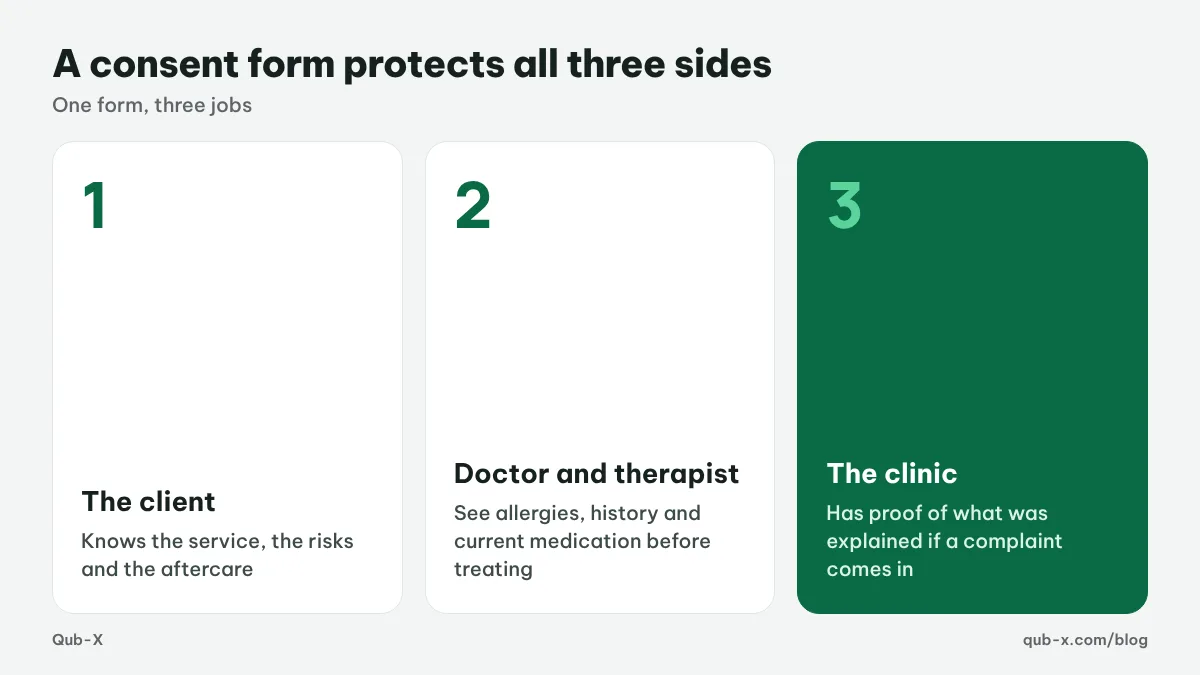
For the client: they know what will be done, which risks may occur and how to look after themselves.
For the doctor and technician: they have the client's allergies, history and current medication before starting.
For the clinic: it is evidence of what was explained if a complaint arises.
The Law on Medical Examination and Treatment No. 15/2023/QH15, in effect from 01/01/2024, recognises the patient's right to be informed and given explanations about their health condition and treatment methods. A consent form is how a clinic shows it did that. A spa that only offers ordinary skincare is outside the scope of this law, but should still use a form to avoid disputes.
Which 8 sections should an aesthetic treatment consent form have?
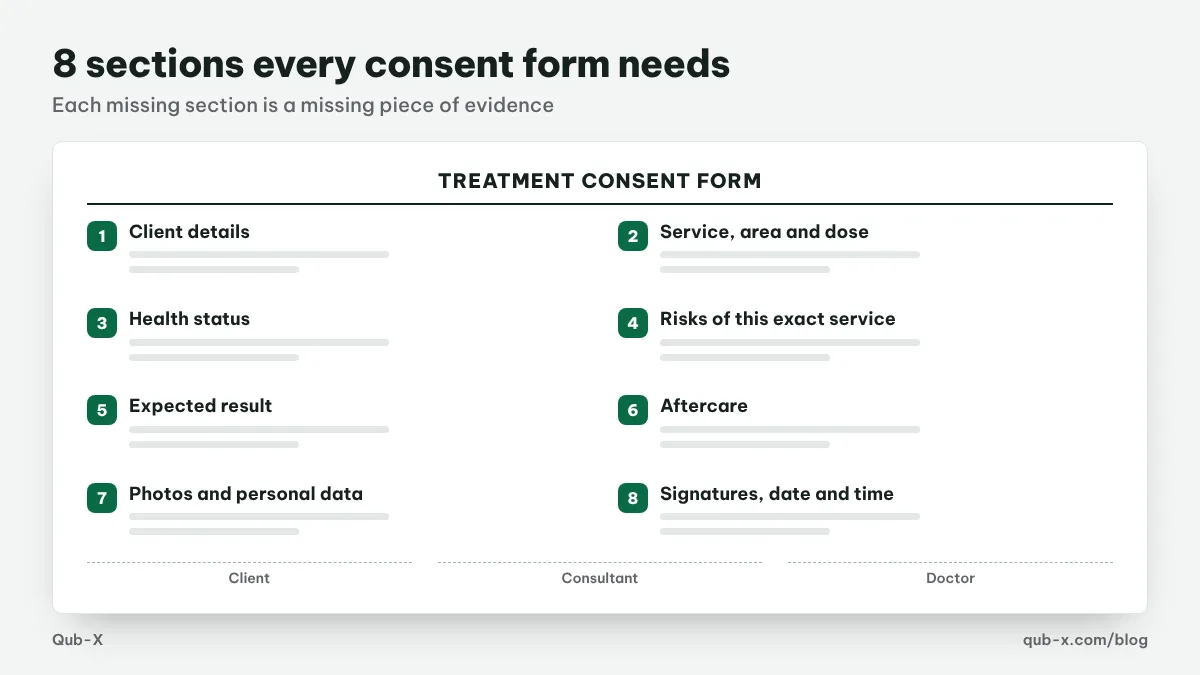
Section | What to record | Common mistake |
|---|---|---|
1. Client details | Full name, date of birth, phone number, ID if needed | Only a nickname, so the client cannot be verified |
2. Service | Service name, treatment area, product and dosage, who performs it | A vague entry such as "filler injection" |
3. Health status | Allergies, underlying conditions, current medication, pregnancy or breastfeeding | Asked verbally, not written down |
4. Risks | Common and rare side effects of that specific service | One risk paragraph reused for every service |
5. Expected results | Achievable results, expected number of sessions, no absolute guarantees | The consultant promises more verbally than the form says |
6. Aftercare | What to do, what to avoid, warning signs to report at once | Given verbally, and the client forgets |
7. Photos and data | Consent to take photos for follow-up; separate consent if photos are used publicly | Both combined in one tick box |
8. Signatures | Signatures of the client, the consultant and the doctor; date and time of signing | Missing date, missing doctor's signature |
Section 7 involves personal data. The Law on Personal Data Protection No. 91/2025/QH15 gives clients the right to consent and to withdraw consent (Article 4), so the form should state clearly what the photos will be used for. The article on storing client before-and-after photos covers this in detail (in Vietnamese).
When should the client sign the form?
The client signs after the consultation and before paying or starting the service, not once they are already lying on the treatment bed. There are three moments when they need to sign again:
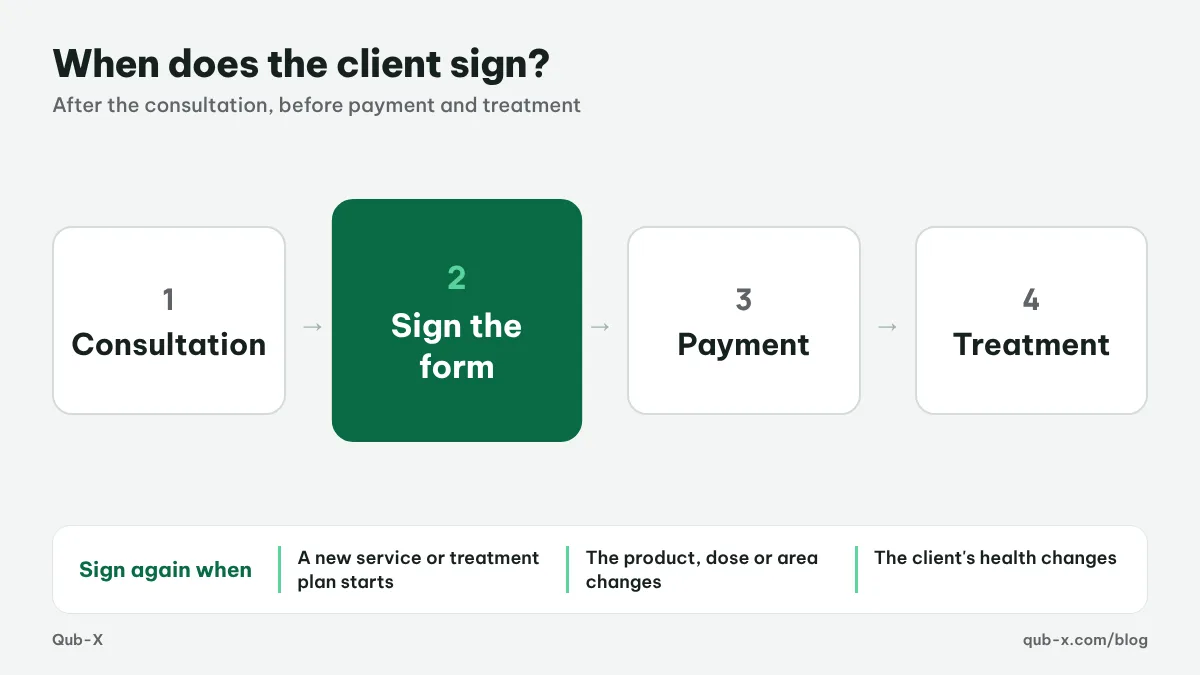
At the first session of a new service or treatment course.
When the product, dosage or treatment area changes from the previous form.
When the client's health changes, for example pregnancy or a new medication.
How should you store consent forms so you can find them later?
The form needs to sit in the right client's record, linked to the right service and signing date. A paper form kept in a cabinet has three weaknesses: it is hard to find when a client complains months later, other branches cannot see it, and it is easily lost when you move premises.
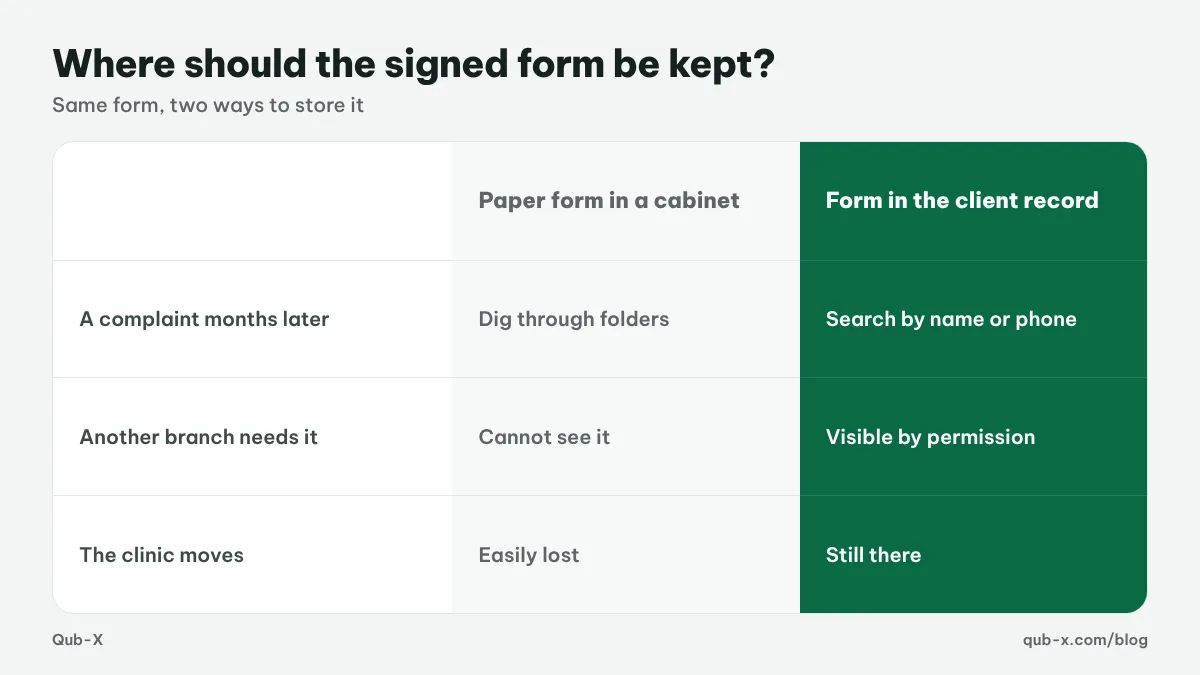
The simplest way is to add the signed copy to the client's record the same day, and only then file the paper copy. This is also one step in the operating process of an aesthetic clinic (in Vietnamese).
Where does Qub-X store the consent form?
In Qub-X, a signed consent form is stored with the client, in the medical record section of the customer record. That section also shows allergies, history and current medication at the top, so the person performing the service can see both before starting. Viewing rights are set by role, and the log records who opened the record. See the page on Qub-X customer records.
Frequently asked questions
What is the difference between a consent form and an agreement form?
The purpose is the same: to record that the client was given an explanation and agreed. The name varies from clinic to clinic. What matters is whether the content covers all 8 sections.
Once the client has signed, is the clinic free of responsibility?
No. The form shows the clinic gave full advice, but it does not remove responsibility for professional errors. Have your legal officer review the form's content; this article is not a substitute for legal advice.
Should you use one form for every service?
No. The client details and signature sections can be shared, but the risks and aftercare sections must be written separately for each service.
If you want to see what a consent form looks like inside a client record, you can book a free demo, a session of about 10 minutes over Google Meet.
Related articles
All articles on Regulations & EMR- Regulations & EMR
Aesthetic clinic regulations 2026: 6 areas you must get right
2026 brings many new legal documents for aesthetic and dermatology clinics: electronic medical records, electronic prescriptions, personal data, a new penalty decree and advertising rules. Here is a summary of the key dates and a compliance checklist.
- Regulations & EMR
CRM vs EMR: What Is the Difference and Which Does an Aesthetic Clinic Need?
CRM manages customer relationships; an EMR records treatment. Here is a 6-point comparison and 3 questions to ask vendors before you choose software for an aesthetic clinic.
- Regulations & EMR
E-prescribing in Vietnam: what clinics need to know about the National Prescription System
Since 1 January 2026, clinics in Vietnam must use e-prescribing, and some provincial Departments of Health are checking that prescriptions reach the national system. What aesthetic and dermatology clinics need to know about Circular 26/2025/TT-BYT, connection codes and ICD-10.