
Aesthetic clinic operations: a 7-step process and SOP checklist
Having enough staff yet always feeling short-handed is usually a sign of a fragmented process. Here are 7 standard steps from intake to follow-up visit, with a responsibilities table and a checklist for each step.
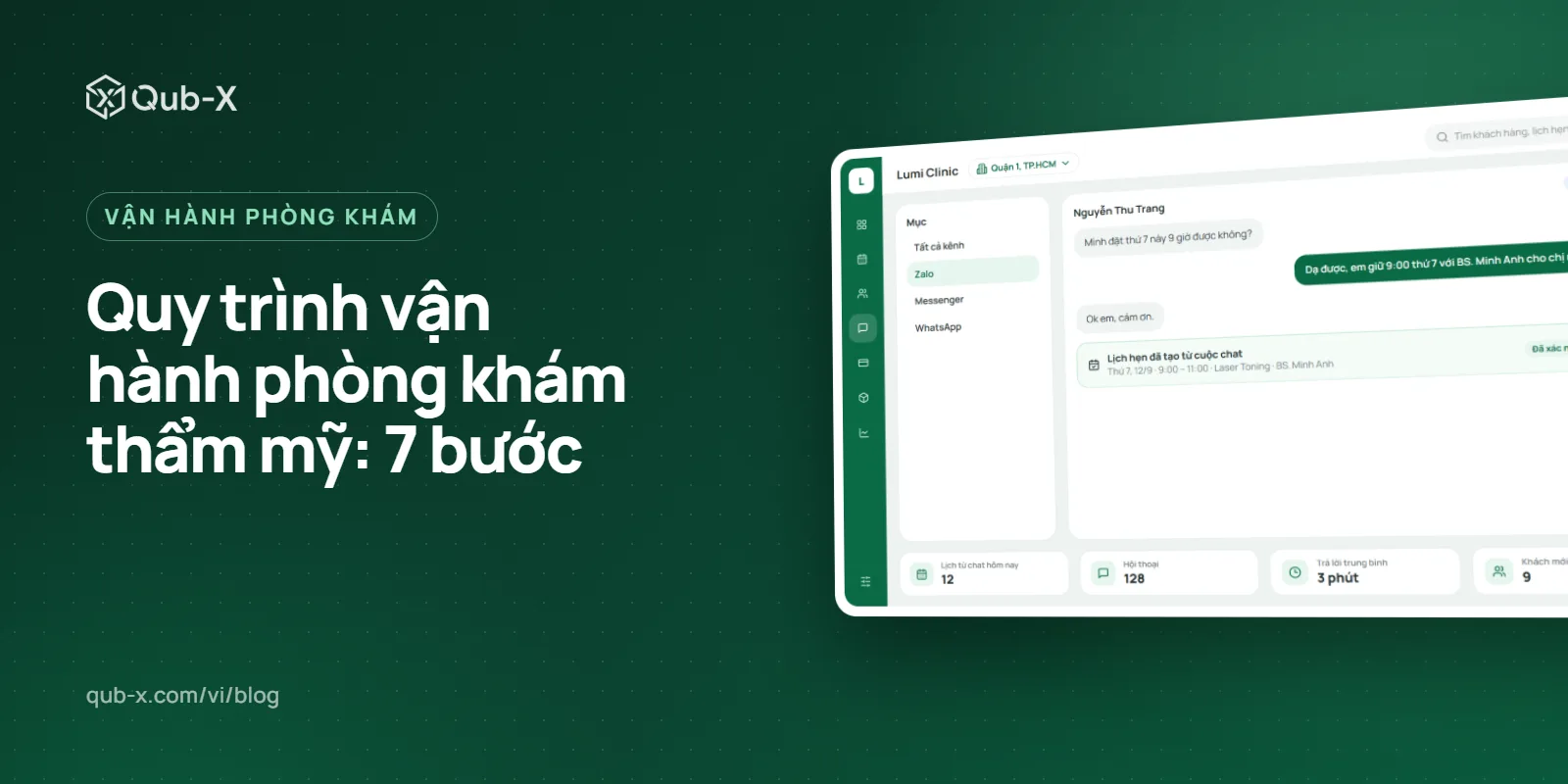
A standard process for aesthetic clinic operations has 7 connected steps: intake, consultation, booking, check-in, examination and treatment, payment, and aftercare and follow-up visits. Each step needs a clear status, an owner and a defined output that is handed over to the next step. Without these three things, staff have to make up the difference through sheer effort, and the clinic ends up with enough people yet always feeling short-staffed.
Signs your operations process is fragmented
The clinic has enough front desk staff, consultants, therapists and doctors, yet every day it feels short-handed. The front desk answers the phone while messaging customers on Zalo to confirm appointments, consultants have to run over and ask the doctor what a customer had done last time, and the accountant only finds out at the end of the day that a customer hasn't paid.
The cause is usually not a lack of staff, but the fact that each step is handled as a separate job. Run a quick check:
The same customer information is entered in two or three different places.
The next step depends on someone remembering to message someone else.
No one knows exactly which stage a customer is at: consulted, booked, treated or paid.
Aftercare gets forgotten because no one owns it.
If you see two or more of these signs, the clinic should standardize its process before thinking about hiring more people.
The 7 steps of the aesthetic clinic operations process
The table below is a reference framework. The role names may differ at your clinic, but the principle stays the same: each step has one person accountable for it and a clear output handed over to the next step.
Step | Owner | Output handed to the next step | Common mistakes |
|---|---|---|---|
1. Intake | Consultant covering the channel | Customer record (new or existing) linked to the conversation | A new record is created for a returning customer |
2. Consultation | Consultant | Needs, services of interest and health notes recorded in the customer record | Notes stay in personal chats |
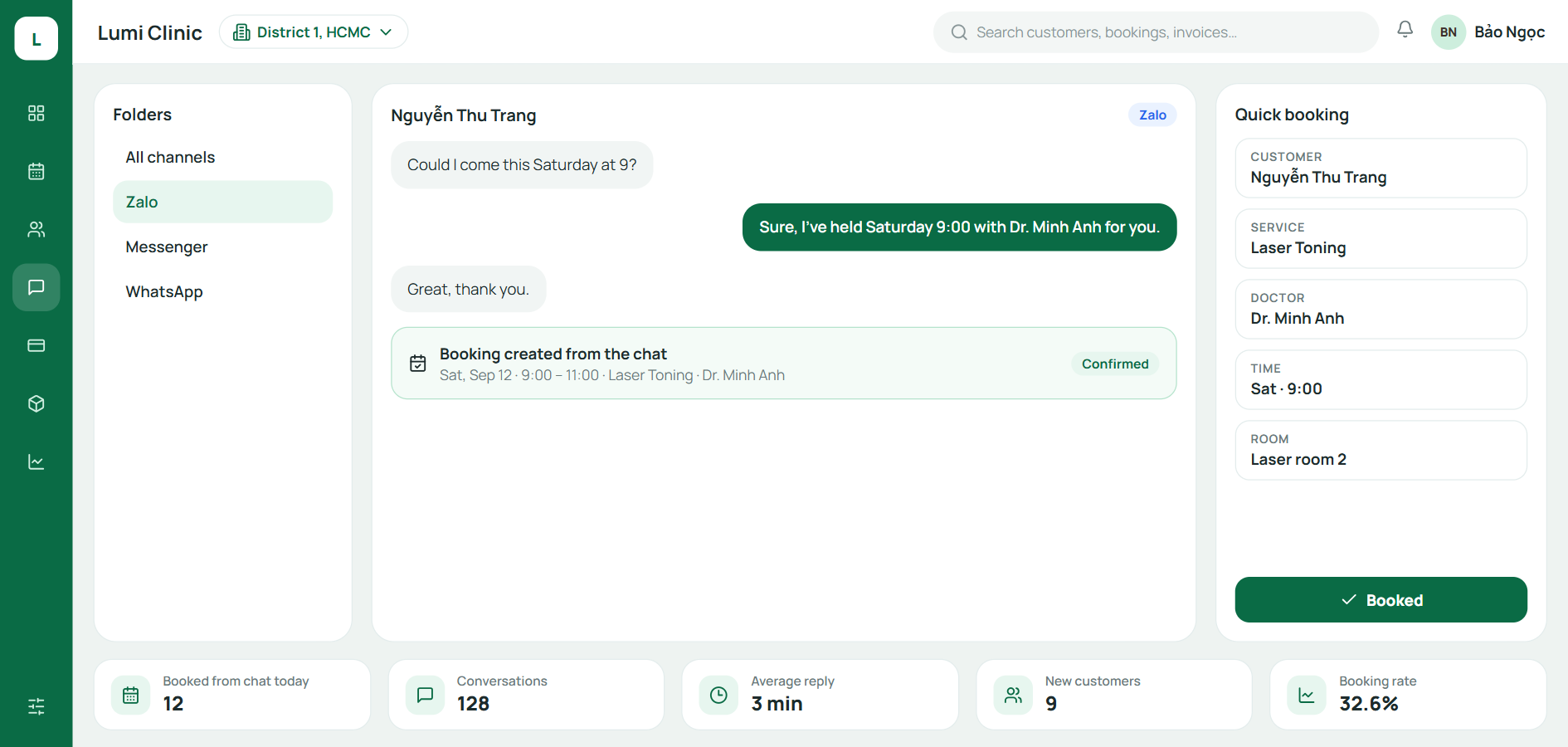
3. Booking | Consultant or front desk | Appointment with the service, doctor or therapist, and room | Double bookings, no room available |
4. Check-in | Front desk | Customer's arrival confirmed, missing details updated | Customer has to explain everything again from scratch |
5. Examination and treatment | Doctor, therapist | Treatment notes, doctor's orders, photos (if the customer consents), sessions used | Written on paper and re-entered later |
6. Payment | Cashier | Invoice, treatment package session deducted, outstanding balance updated | No one knows which package the customer is using |
7. Aftercare and follow-up visit | Consultant or customer care | Aftercare call and follow-up visit scheduled, each with an owner | No one sends a reminder, so the customer doesn't come back |
Step-by-step details and the handoffs to connect
Steps 1–2: intake and consultation
Every message and every call must be linked to a customer record from the very start. If the customer has visited before, the consultant needs to see their service history before replying. Health notes the customer shares during the consultation, such as allergies or pregnancy, must be recorded in their file, not left sitting in the chat thread.
Steps 3–4: booking and Check-In
The appointment should be created during the consultation itself, on a shared calendar that the front desk, doctors and therapists can all see. When the customer arrives, the front desk only needs to confirm and fill in any missing details, rather than asking the customer to explain their needs all over again.
Step 5: examination and treatment
For clinics licensed to provide medical examination and treatment, this is the step tied to medical records as required by regulation. Our article on electronic medical records for aesthetic clinics summarizes which facilities must implement them and the deadline. Before-and-after photos should only be taken, stored and used once the customer has given consent.
Step 6: payment
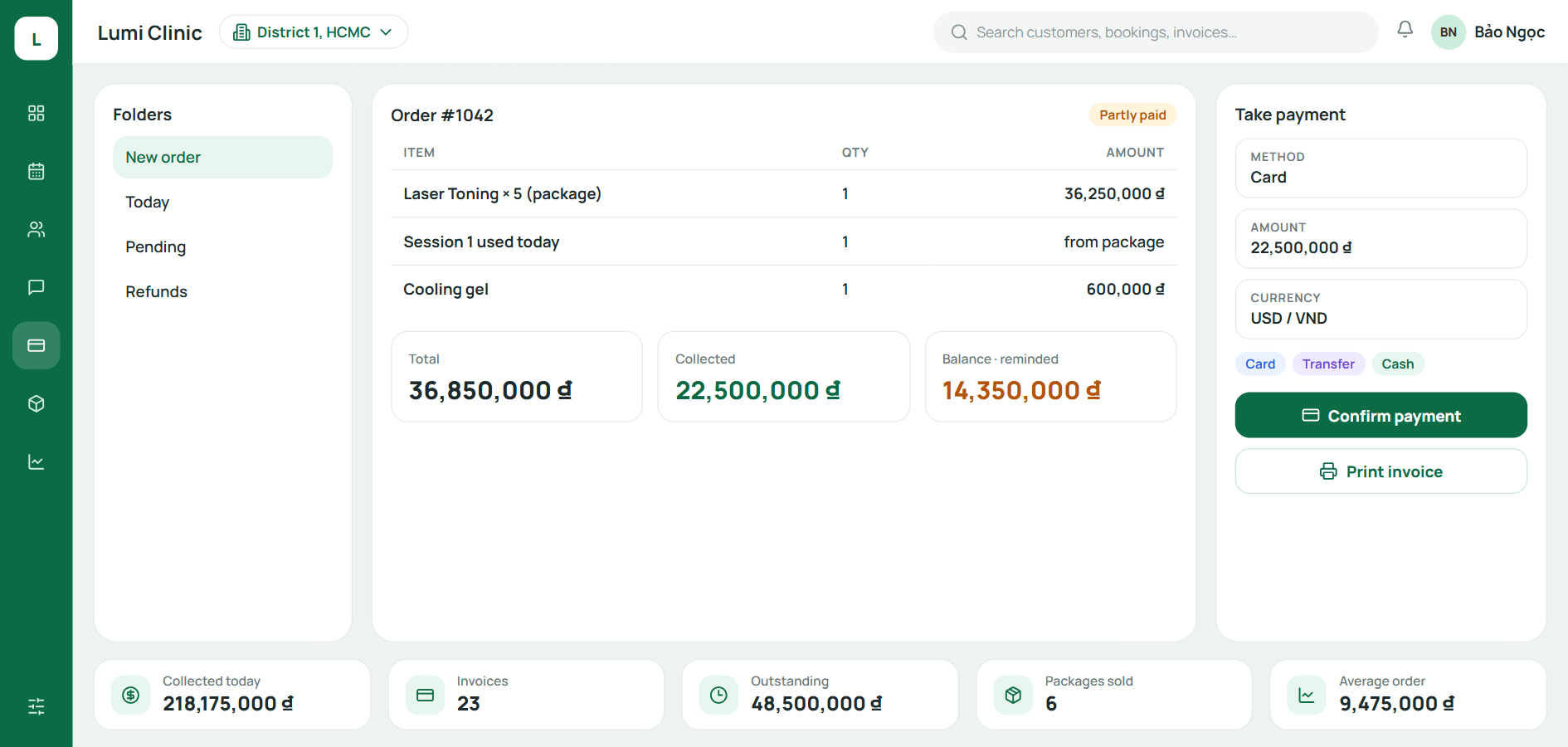
The cashier needs to see straight away which services were performed and which treatment package the customer is using, so they can deduct the session and charge the correct amount. If the cashier has to run over and ask the therapist, that is the first bottleneck to fix.
Step 7: aftercare and Follow-Up visits
Once payment is complete, an aftercare check-in should be created automatically, with an owner and a deadline. This is the step that gets forgotten most often, yet it is the one that decides whether the customer comes back.
How to map the customer journey in one meeting
Before choosing any tool, sit down with your team for about 60 minutes and walk through the journey of a typical customer:
Pick your clinic's most popular service.
Retrace every step the customer goes through, from the first message to the aftercare check-in after treatment.
At each step, note three things: who does it, what information they need, and where that information currently lives.
Circle every point where information has to be passed along by hand or entered again.
This exercise usually reveals a few very specific bottlenecks. For example, a consultant confirms a booking but the front desk can't see it on the shared calendar, or a doctor finishes a treatment but the cashier doesn't know which package the customer is on. Those are the handoffs to connect first.
SOP checklist for each step
Use this checklist to write a concise standard operating procedure (SOP) for your clinic. Each step only needs one page.
When does this step start, and when does it end?
Who is primarily responsible? Who covers when that person is away?
What information is needed, and where does it come from?
What is handed over to the next step, and through which channel?
What is the maximum time allowed for this step?
How are the most common exceptions handled?
Which metric is used to measure this step?
Start with your Highest-Frequency journey
Don't try to standardize everything at once. Pick the journey that repeats most often each day, usually from the first message to the first appointment, and get it running smoothly first. Once the team is used to it, extend the same principles to treatment, payment and aftercare.
A good process needs one system that holds a shared status for every department. Our guide to spa management software helps you choose the right tool. If your clinic is looking for a system like this, Qub-X connects every step, from the inbox, appointments and customer records through to payment, on a single platform.
Frequently asked questions
What is an SOP for an aesthetic clinic?
An SOP (standard operating procedure) is a document that describes each step of a task: who does it, when it is done, what information is needed and who the result is handed over to. SOPs help new staff get things right from day one and keep the clinic running steadily even when the team changes.
Does a small clinic need a written operations process?
Yes, but it doesn't need to be long. One page for each of the 7 steps is enough, as long as everyone understands it and follows it.
How do spa and aesthetic clinic processes differ?
The biggest difference is in the examination and treatment step. A licensed clinic must have a doctor examine the customer, issue medical orders and create medical records as required by regulation; a spa only provides care services, so its process is simpler.
How often should we review our processes?
Review them every quarter, and immediately after any major change such as opening a new branch, adding a new service or switching software. The points where staff keep having to ask each other questions are signs that the process needs fixing.
Related articles
All articles on Staff & commission- Staff & commission
Spa customer records: bring scattered customer data into one place
When consultation notes live in chat, treatment history in a notebook and payments in a spreadsheet, a spa loses more than search time. What should a customer record hold, and how do you bring it all into one place?
- Staff & commission
Spa management software: how to choose one for your whole workflow
Good spa management software brings consultations, appointments, customer records, treatment packages, payments and aftercare into one system. This guide helps you choose the right one and roll it out without disrupting your daily operations.
- Electronic medical records
EMR for Aesthetic Clinics: Which Facilities Must Implement by December 31, 2026, and How to Prepare
Under Circular 13/2025/TT-BYT, aesthetic and dermatology clinics licensed to provide medical examination and treatment must complete the implementation of electronic medical records by December 31, 2026. This article summarizes which facilities are in scope, what to prepare, and how Qub-X is building its EMR feature.