
CRM vs EMR: What Is the Difference and Which Does an Aesthetic Clinic Need?
CRM manages customer relationships; an EMR records treatment. Here is a 6-point comparison and 3 questions to ask vendors before you choose software for an aesthetic clinic.
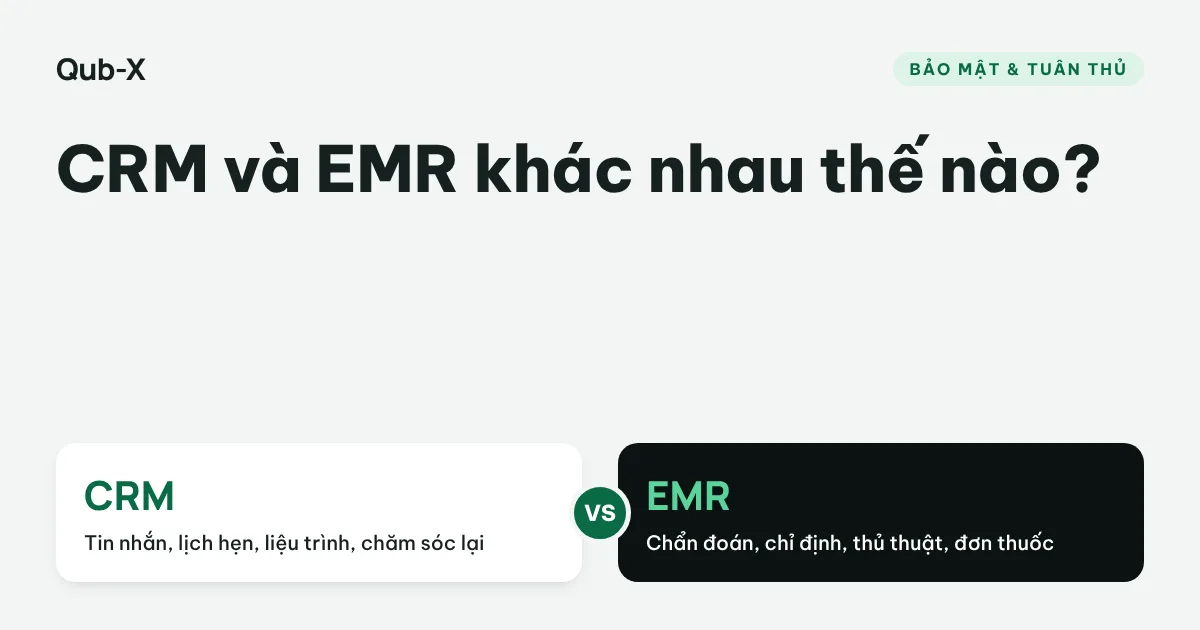
CRM and EMR often get lumped together as "clinic management software," but they answer two different questions. A CRM answers: who is this client, where did they come from, what have they bought, and when do they need follow-up? An EMR answers: what did the doctor examine, order, perform, and prescribe? An aesthetic clinic needs both answers, so the right question is not which one to pick, but whether the two sit in the same client record.
What is a CRM and what does it do in a clinic?
CRM (Customer Relationship Management) is software for managing client relationships. In an aesthetic clinic, the CRM handles everything before and after the treatment session:
Pulls messages from Facebook, Zalo, and your website into one place and records where each client came from
Books appointments, sends reminders, and assigns doctors and rooms
Tracks treatment packages: sessions used, sessions left, and the balance still owed
Sends follow-up reminders, aftercare messages, and invitations for returning clients
Reports on revenue, closing rate, and return rate
If you want a closer look at the concept, see what CRM software is.
What is an EMR and how is it different from an ordinary client record?
An EMR (Electronic Medical Record) is the digital version of a medical record: the clinical record of each visit, created by a licensed practitioner who is responsible for it. A record typically includes medical history, allergies, diagnosis, orders, procedure notes, prescriptions, before-and-after photos, and the client's consent forms.
It differs from a CRM client record in three ways: who can write to it (licensed practitioners), who can view it (access is far more restricted than for sales data), and whether it can be edited once written (every change must leave a trace).
CRM vs. EMR comparison table
Criteria | CRM | EMR |
|---|---|---|
Purpose | Win clients, keep clients, grow revenue | Record and store the examination and treatment process |
Main users | Receptionists, consultants, client care staff, managers | Doctors, nurses, technicians |
Main data | Contacts, lead source, appointments, treatment packages, payments | History, diagnosis, orders, procedures, prescriptions, images |
When it is used | Before and after the treatment session | During the examination and treatment |
Access control | By role and branch | By practitioner, with an access log |
How success is measured | Closing rate, return rate, revenue | Records that are complete, correct, and retrievable |
Why shouldn't an aesthetic clinic split them into two systems?
A client visit at an aesthetic clinic goes through five steps, and the medical record is only the one in the middle:
The client messages to ask about a service; a consultant replies and records the source
An appointment is booked and the receptionist greets the client
The doctor examines, gives orders, and writes the record
Payment is taken and a session is deducted from the treatment package
Aftercare and follow-up reminders
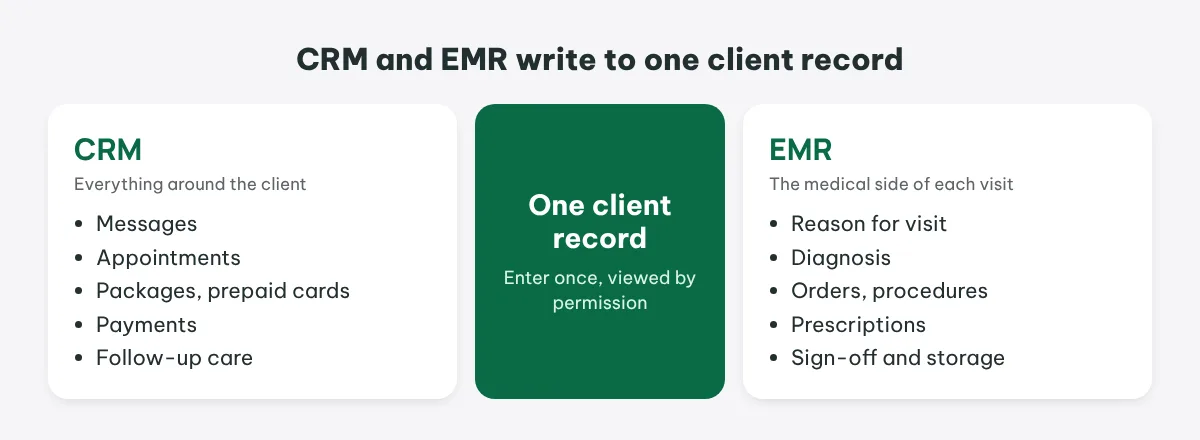
When the CRM and EMR are two separate programs, step 3 is cut off from the other four. The usual consequences:
Double entry: name, phone number, and date of birth are typed in both places and easily end up mismatched
The consultant doesn't know about a client's contraindications, and the doctor doesn't know which package the client has bought
The doctor's orders don't automatically become services on the invoice, so the receptionist has to ask again
Follow-up reminders are done by hand because the care schedule can't read the treatment date in the medical record
Two places to manage access, two backups, two software contracts
3 questions to ask a vendor before you choose
Starting from one client's record, how many clicks does it take to open that client's medical record? Do you have to log in to a different system?
Which parts of the medical record can consultants and receptionists see? How finely can access be set, and is there a log of who viewed it?
Do the orders in the medical record connect to the appointment, the invoice, and the follow-up reminder, or do you have to enter them again?
Ask the vendor to do all three live on screen during the demo, rather than just listening to a description.
Does a facility that doesn't provide medical services need an EMR?
Under Circular 13/2025/TT-BYT, creating electronic medical records applies to medical examination and treatment facilities. A facility that only offers non-invasive skin care and has no medical practice license generally falls outside this group, and a CRM with client records and before-and-after photos is enough. A licensed clinic where doctors perform injections, lasers, or minor surgery needs a medical record in the proper sense.
Circular 13 applies to every licensed medical facility whatever its size or specialty, and clinics must finish by 31 December 2026; if you are unsure whether your facility is covered, check your practice license and ask your local Department of Health. The preparation steps are in our electronic medical record implementation checklist.
How does Qub-X combine CRM and EMR?
Qub-X is a CRM for aesthetic clinics with a built-in electronic medical record (on the Accelerate and Customizing plans). The multichannel inbox, appointments, treatment packages, payments, and medical records share one client record: the doctor writes the record right inside that file, while receptionists and consultants see only the parts they have been given access to. See the details on the electronic medical record feature page.
TIP: Before watching a demo of any software, write down the path of one real client from the first message to the follow-up visit. Software that covers the whole path without you opening another tool is worth a trial.
Conclusion
A CRM handles winning and keeping clients; an EMR handles recording treatment. An aesthetic clinic does both for the same person, so both parts should sit in one record. You can try Qub-X free for 7 days to test the three questions above with your own data.
Frequently asked questions
How do EMR, EHR, and HIS differ?
An EMR is the electronic medical record within a single facility. An EHR is an electronic health record that follows a person across multiple facilities. A HIS is a hospital information system that also manages hospital fees, pharmacy stock, and inpatient care. Aesthetic clinics usually need an EMR, not a HIS.
If I already have a CRM, do I have to re-enter data when I add an EMR?
If the EMR is a separate program, you usually have to re-enter or manually sync data. If the EMR is built into the CRM, the medical record attaches directly to the existing client record, and no second client is created.
Can a CRM replace an EMR?
No. Notes in a CRM client record are not a medical record: they lack clinical structure and any rules about who can write and edit. For a medical examination and treatment facility, the medical record should be created in a tool built for it.
Related articles
All articles on Security & compliance- Security & compliance
E-prescribing in Vietnam: what clinics need to know about the National Prescription System
Since 1 January 2026, clinics in Vietnam must use e-prescribing, and some provincial Departments of Health are checking that prescriptions reach the national system. What aesthetic and dermatology clinics need to know about Circular 26/2025/TT-BYT, connection codes and ICD-10.
- Security & compliance
EMR implementation for aesthetic clinics: a checklist before 31 December 2026
Fewer than 6 weeks remain until 31 December 2026. This 6-step checklist covers EMR implementation for aesthetic and dermatology clinics under Circular 13/2025/TT-BYT, without pausing appointments.
- Security & compliance
EMR Software That Meets Vietnam Ministry of Health Standards
The 31 December 2026 deadline is close for every licensed clinic. This guide helps aesthetic and dermatology clinics understand what the Ministry of Health requires and choose EMR software that gets them there in time.