
Clinic E-Invoices: When to Issue Them and 5 Mistakes to Avoid
A clinic e-invoice is issued when the service is completed, or when you collect payment if the client paid in advance. Includes a 4-case table, 5 common mistakes and a 4-step process.

In this article · 6 sections
A clinic e-invoice must be issued when the service is completed, or at the moment you collect payment if the client paid in advance. Most invoice errors at aesthetic clinics are not about the rules. They come from retyping data by hand from the order into the invoicing software.
Updated 26/11/2026. This article is not tax advice; ask your accountant about your clinic's specific case.
Quick summary
From 01/7/2026, e-invoices follow Decree 254/2026/NĐ-CP, which replaces Decree 123/2020/NĐ-CP.
Services: issue the invoice on completion; if you collect payment in advance, issue it when you collect.
The 5 common mistakes all come from manual entry: wrong timing, wrong client details, mismatched amounts.
The simplest approach is to create a draft invoice straight from the order, then have the accountant check and sign it.
When must a clinic issue an e-invoice?
For services, the invoice is issued when the service is completed, whether or not you have been paid. If you collect payment in advance or during the service, issue the invoice at the time of collection. This rule is in clause 2, Article 9 of Decree 254/2026/NĐ-CP, effective from 01/7/2026, replacing Decree 123/2020/NĐ-CP and Decree 70/2025/NĐ-CP, according to the EY tax alert of July 2026.
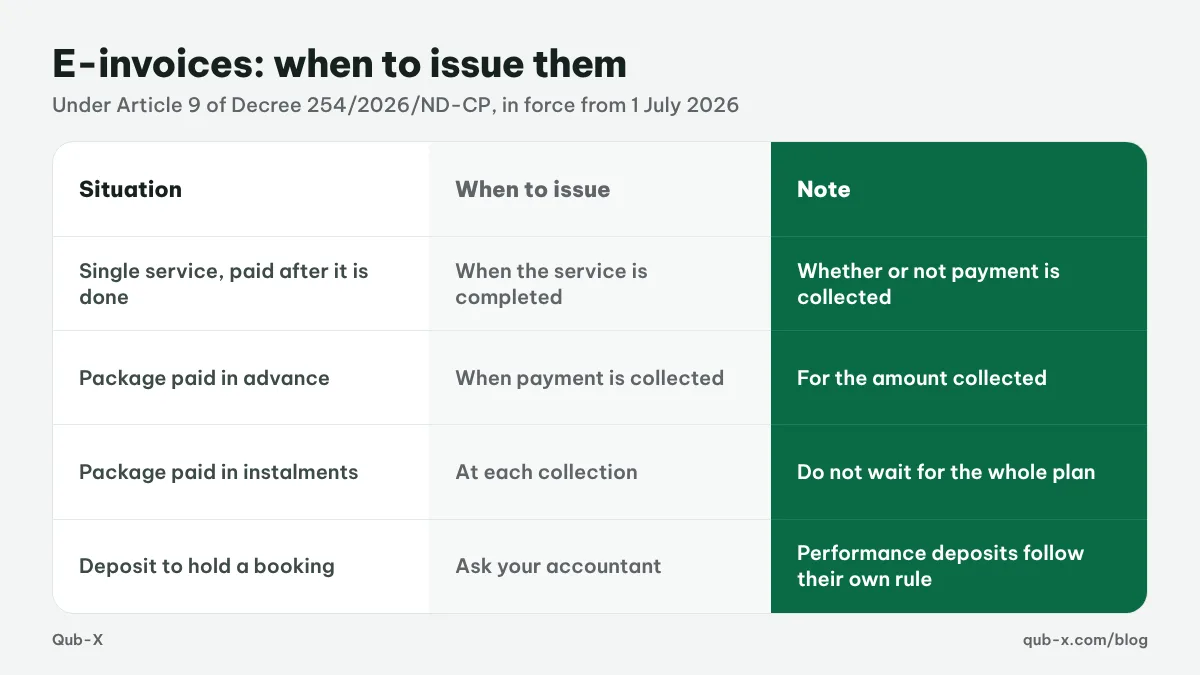
Situation at the clinic | When to issue the invoice | Note |
|---|---|---|
Single service, client pays after it is done | On completion of the service | Does not depend on whether you have been paid |
Client buys a treatment package and pays in advance | When you collect payment | Issue for the amount collected |
Client pays for a multi-session package in instalments | Each time you collect payment | Do not wait until the course ends to issue one invoice |
Client pays a deposit to hold an appointment | Ask your accountant | Deposits that secure contract performance have their own rules |
More specific cases are collected in the invoice timing section of Thư viện Pháp luật.
What are the 5 most common e-invoice mistakes at clinics?
All five mistakes below come from the order living in one place and the invoice in another, with someone retyping in between.
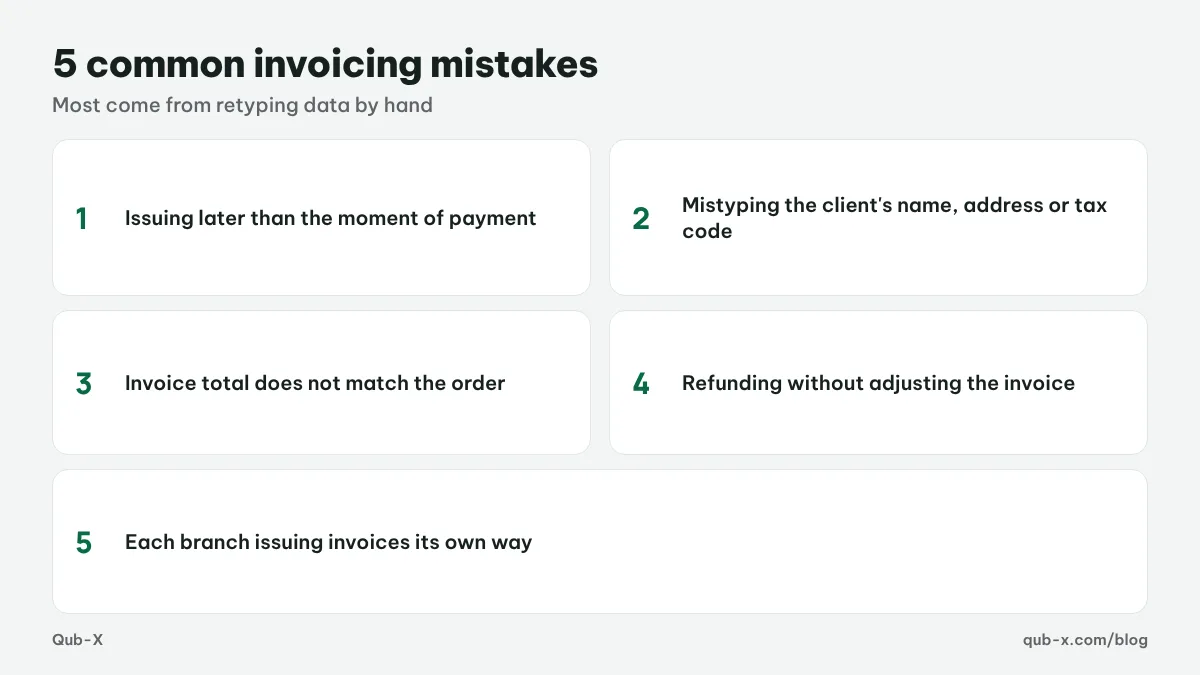
Issuing later than the payment date. The receptionist collects payment during the day, but the accountant batches invoices and issues them at the end of the week.
Wrong buyer details. Name, address and tax code are retyped from the client's chat messages.
Amount differs from the order. The order has a discount or partial payment, but the invoice shows the full price.
Refunding without adjusting the invoice. The money went back to the client, but the invoice stays as it was.
Every branch does it differently. One branch issues immediately, another lets invoices pile up, and reconciling becomes hard.
How many steps from order to invoice?
The simplest process has 4 steps, and data is entered only once, at the order:
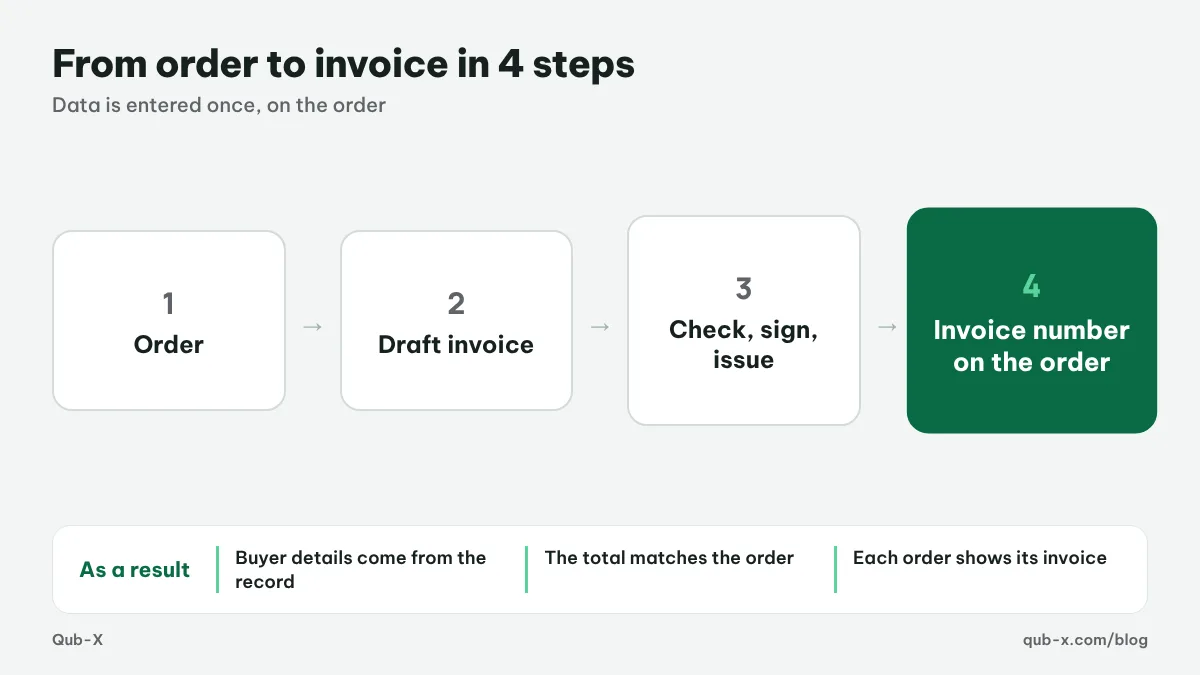
Create the order with the correct service, price, discount and amount the client paid.
Create a draft invoice from that same order, with buyer details taken from the client record.
The accountant checks, signs and issues it in the e-invoicing software.
The invoice number goes back to the order, so later, opening the order shows the invoice.
If step 1 is done right, the next three steps need almost no retyping. To see where payment and invoicing fit, read our 7-step aesthetic clinic operations process.
How does Qub-X support e-invoicing?
Qub-X includes e-invoice integration in every plan. We connect it, at no charge, to the e-invoicing provider your clinic has already bought, so invoicing sits alongside orders and payments in one place. Qub-X does not issue invoices on its own: signing and issuing remain the clinic's responsibility. Details are on the Qub-X payments and invoicing page.
Frequently asked questions
If a client prepays a whole course, do I issue one invoice or one per session?
Under the rule that advance payments are invoiced when collected, the amount the client has paid is invoiced at the time of collection. Your accountant should confirm how to record each type of package.
Does each branch need its own invoicing account?
It depends on how the clinic is registered for tax. The software should support both: one shared account or a separate account per branch.
How do I handle the invoice when I refund a client?
If the invoice has already been issued, you need to issue an adjustment invoice. See also our article on debt management software for clinics for how to track what clients still owe after each order.
To see how an invoice is prepared from an order, you can book a free demo, about 10 minutes over Google Meet.
Related articles
All articles on Clinic operations- Clinic operations
Spa treatment card: a template and how to track sessions left
A spa treatment card records which package a client bought, how many sessions they have used and how many are left. This guide gives a two-sided card template, an A5 sheet, three common print sizes and an end-of-day check that prevents disputes.
- Clinic operations
Clinic software: 6 jobs it must handle before you buy
Clinic software should handle six jobs before you pay for it: scheduling, records and EMR, payments, stock, reports and permissions. This guide adds the Vietnamese rules to remember, questions to ask vendors and a 7-day trial plan.
- Clinic operations
Aesthetic clinic treatment packages and prepaid cards: no more session disputes
Disputes over remaining sessions can cost you clients as surely as a disappointing treatment. Here is how to record, deduct and track aesthetic clinic treatment packages and prepaid cards so the client and the clinic always see the same number.