
Spa treatment card: a template and how to track sessions left
A spa treatment card records which package a client bought, how many sessions they have used and how many are left. This guide gives a two-sided card template, an A5 sheet, three common print sizes and an end-of-day check that prevents disputes.
In this article · 8 sections
A spa treatment card records which package a client bought, how many sessions they have used and how many are left. A card done properly carries six pieces of information, the client's signature for every session, and is checked against the spa's own log at the end of each day.
Updated 28 November 2026.
Quick summary
The card needs six items: client name and ID, course, number of sessions, purchase date, expiry date, and a box to sign per session.
Three common print sizes: 85.6 × 54 mm, A6 and A5.
Disputes happen when the client's card and the spa's log disagree; an end-of-day check prevents that.
From around 100 clients with active packages, move session tracking into software.
What is a spa treatment card?
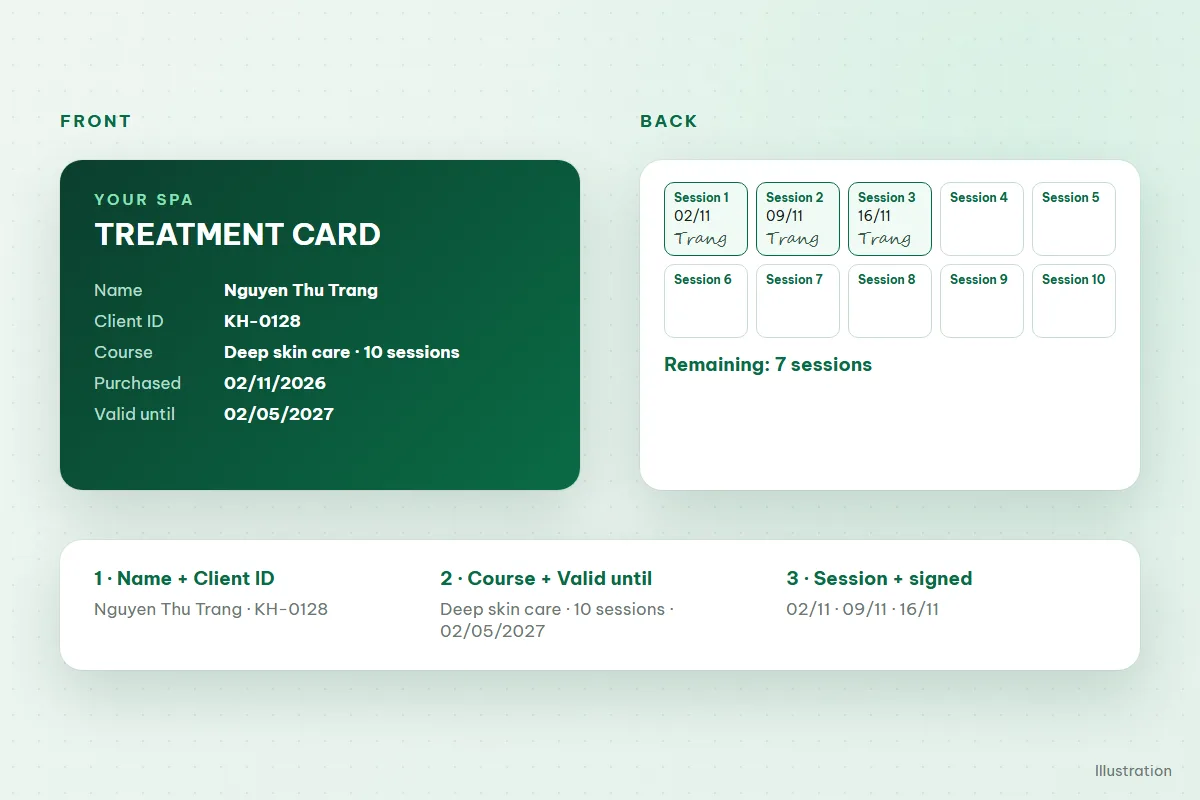
A spa treatment card is the written confirmation between the spa and the client of a prepaid multi-session package. The client keeps the card and hands it over at each visit so one session can be marked.
The card does three jobs:
For the client: how many sessions are left and until when.
For reception: which package the client holds, without searching the logbook.
For the owner: evidence when the two sides remember differently.
You can save the template above and send it to a printer, or rebuild it from the table in the next section.
What should a spa treatment card template include?
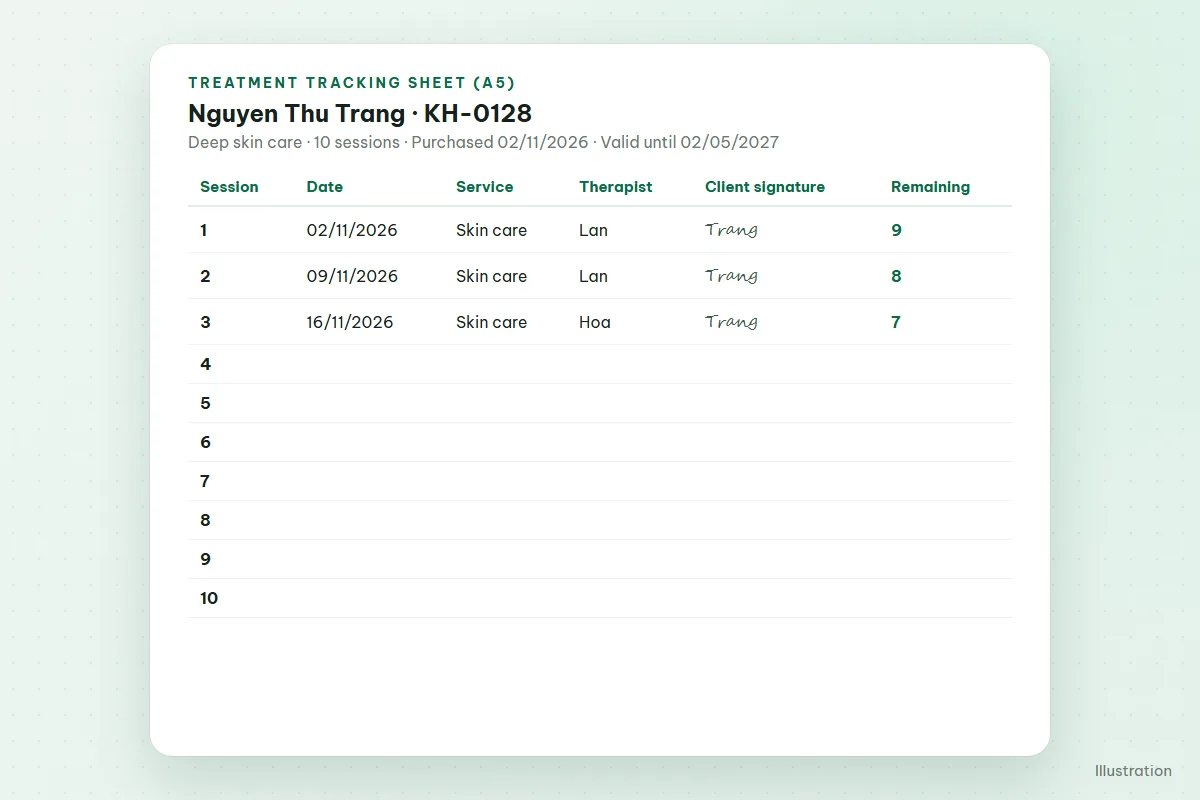
A spa treatment card template needs the six items below. Without any one of them, the card stops being useful in a dispute.
Item | Example | Why it matters |
|---|---|---|
Name and client ID | Nguyen Thu Trang, KH-0128 | Avoids mixing up clients with the same name |
Course | Deep skin care | Shows which service the card covers |
Total sessions | 10 sessions | The base for counting what is left |
Purchase and expiry dates | 02/11/2026, 02/05/2027 | The client knows the expiry from day one |
A box per session | Date, therapist, client signature | Evidence for each visit |
Sessions remaining | Written after each session | The client can read it at once |
Print the package terms on the back: whether it can be transferred, whether it can be refunded, what happens after expiry. Vietnam's Law on Protection of Consumer Rights 2023 requires sellers to give clients accurate and complete information about the service.
If you need an editable file, copy the table in the picture into Word or Excel: six columns, ten rows, printed on A5.
Which size should a spa treatment card be?
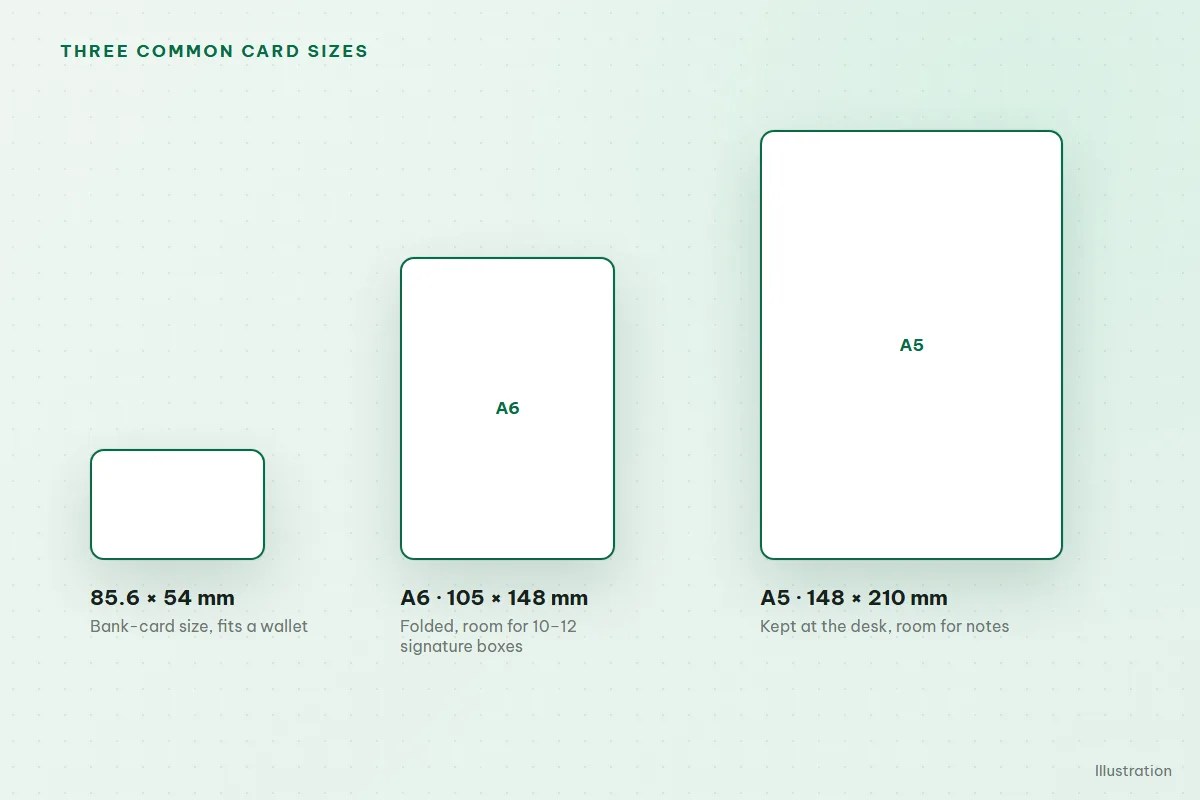
Choose the size by the number of sessions in the package and by who keeps the card.
Size | Dimensions | Suits | Drawback |
|---|---|---|---|
Wallet card | 85.6 × 54 mm | 5–10 session packages, kept by the client | Small signature boxes |
Folded A6 | 105 × 148 mm | 10–12 session packages | Creases easily |
A5 | 148 × 210 mm | A sheet kept at the desk | The client does not carry it |
85.6 × 54 mm is bank-card size and fits a wallet, so clients forget it less often. Use card stock of 250 gsm or more with a matt finish so ballpoint ink does not smear. Many spas use two: a wallet card for the client and an A5 sheet at the desk.
On design: keep to one brand colour, use type of 8 pt or larger, and leave signature boxes wide enough. A good-looking card that cannot be signed is not usable.
How do you track sessions left without disputes?
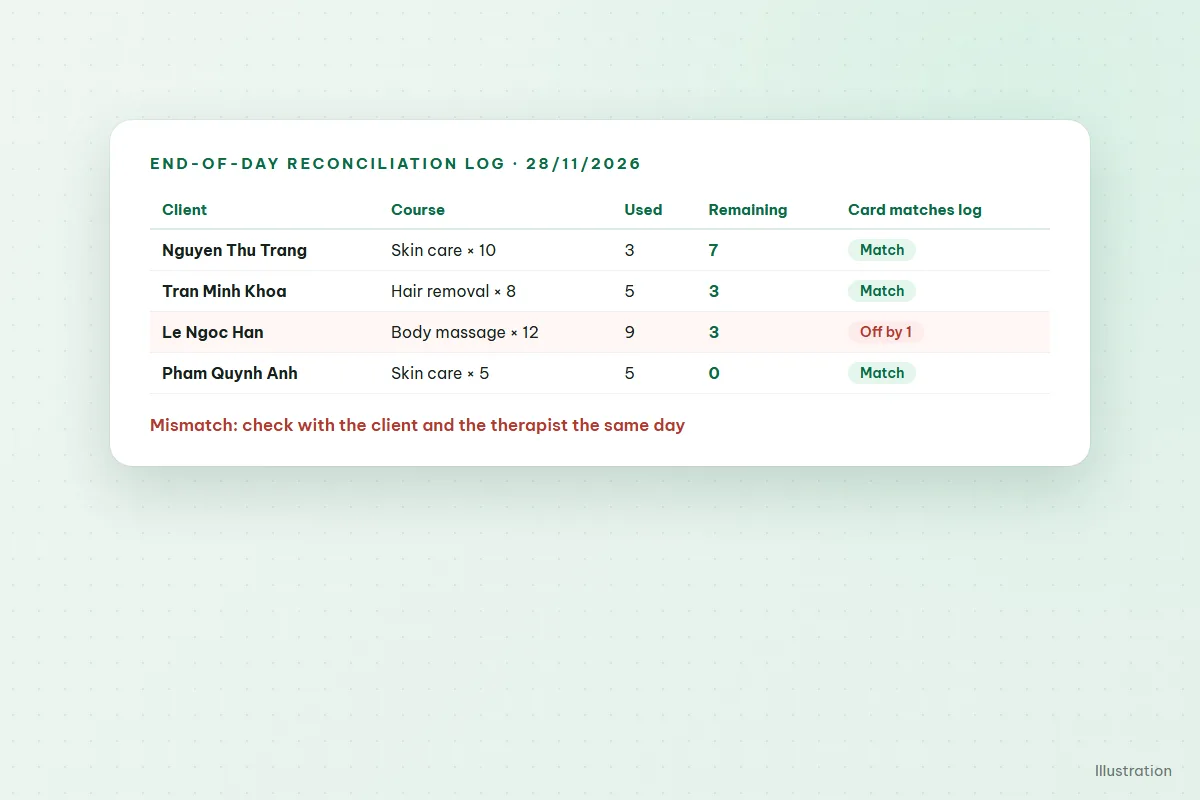
Disputes start when the client's card shows one number and the spa's log shows another. Four steps keep the two in line:
Mark it right after the session: the therapist writes the date and their name, and the client signs before leaving.
Record it in two places: the client's card and the spa's treatment log.
Check at the end of the day: reception compares the log with the day's schedule, as in the picture.
Resolve mismatches the same day: ask the client and the therapist while everyone still remembers.
If a client forgets the card, record the session in the log and add it to the card with a signature next time. If a client loses the card, issue a new one from the log.
When should you move from paper cards to software?
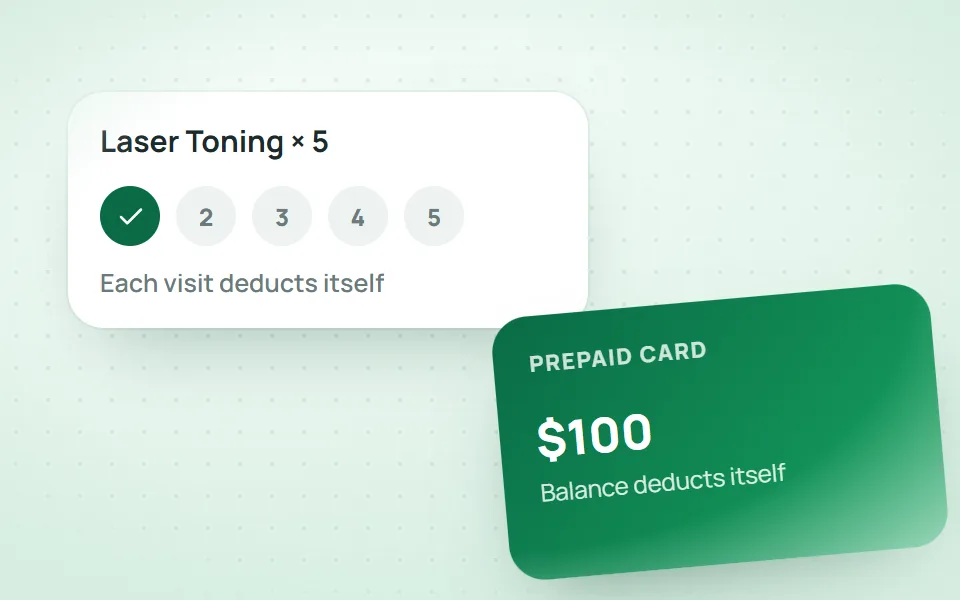
Move to software when the end-of-day check takes more than 30 minutes or the spa has two or more branches. Three common signs:
Around 100 or more clients hold packages with sessions left.
Clients buy at one branch and use sessions at another.
A few times a month the client and the spa remember differently.
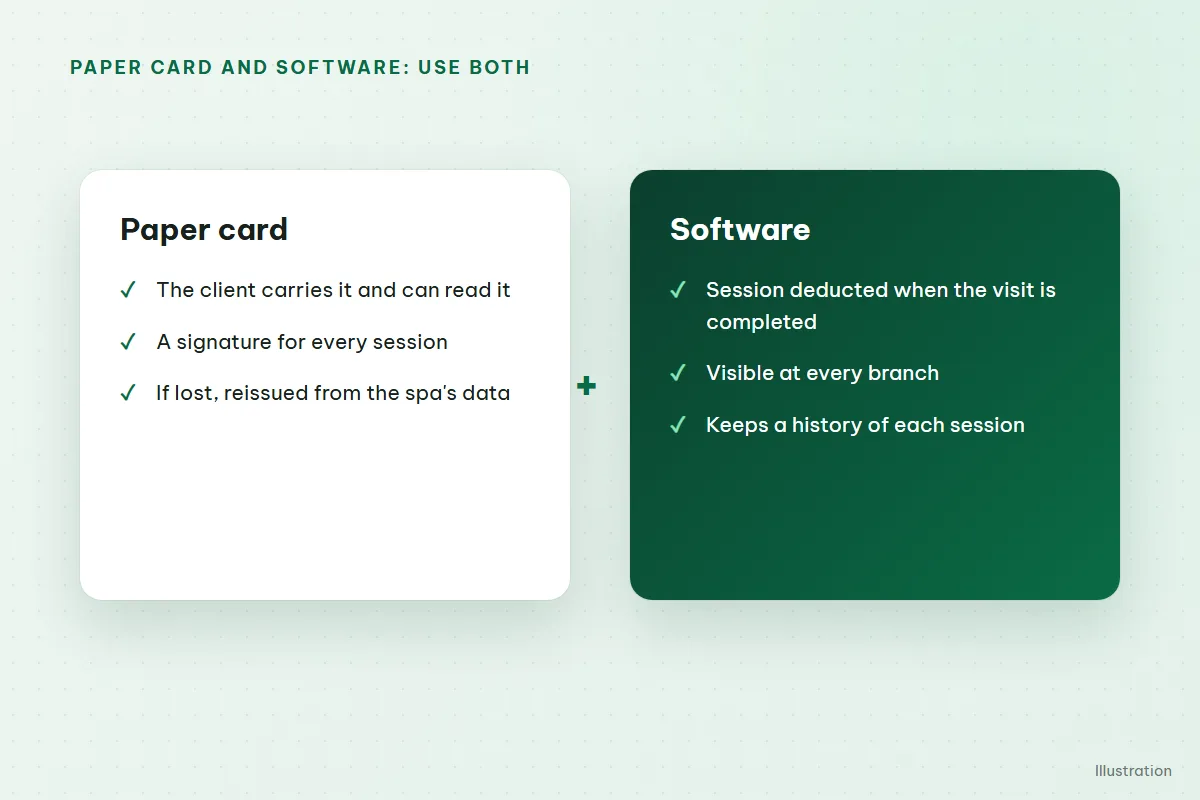
Software does not replace the card. Many spas still hand out a card for the client to hold, while the real count lives in the system.
Each client's session history
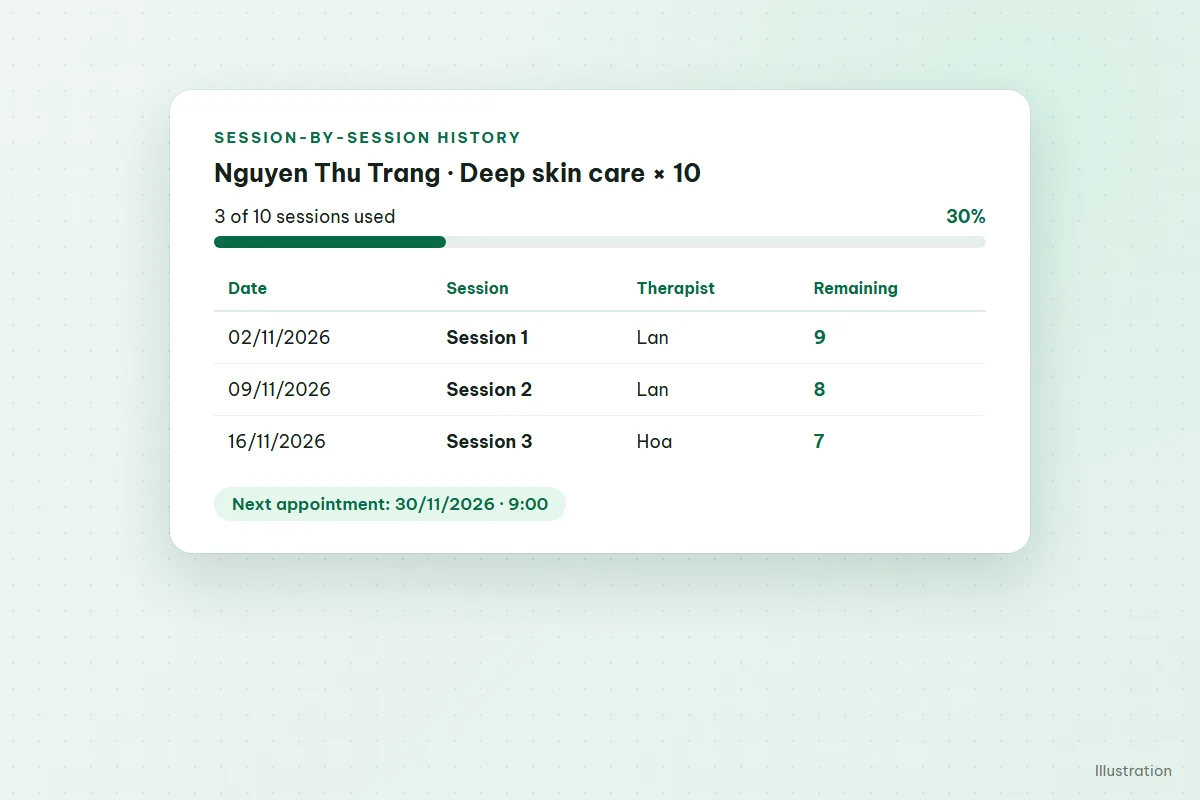
In Qub-X, a session is deducted when the appointment is completed and appears under packages and prepaid cards in the client record. Reception can answer "how many sessions do I have left" without opening a logbook. The full method is in treatment packages and prepaid cards. Our overview for spas is spa management software.
Frequently asked questions
Does a spa treatment card need an expiry date? Yes. A client who knows the expiry at purchase is less likely to complain when the package runs out. Print any extension terms on the back as well.
What if a client loses their treatment card? Issue a new card from the treatment log or the data in the spa's software. That is why the spa always needs its own record and cannot rely on the client's card alone.
Can a spa treatment card be kept in a spreadsheet? Yes, with few clients. One row per client, one date column per session. Once several receptionists edit the same file, entries get overwritten.
Conclusion
A spa treatment card done properly has six items, a signature for each session and a check against the log at the end of every day. As the number of clients with packages grows, let software deduct the sessions and keep the card as the client's copy. To see how Qub-X tracks packages and sessions, book a free demo; it takes about 10 minutes on Google Meet.
Sources
Law on Protection of Consumer Rights No. 19/2023/QH15, Official Gazette of Vietnam (in Vietnamese).
Current rules on protection of consumer rights, Government Document Portal (in Vietnamese).
Related articles
All articles on Clinic operations- Clinic operations
Clinic software: 6 jobs it must handle before you buy
Clinic software should handle six jobs before you pay for it: scheduling, records and EMR, payments, stock, reports and permissions. This guide adds the Vietnamese rules to remember, questions to ask vendors and a 7-day trial plan.
- Clinic operations
Clinic E-Invoices: When to Issue Them and 5 Mistakes to Avoid
A clinic e-invoice is issued when the service is completed, or when you collect payment if the client paid in advance. Includes a 4-case table, 5 common mistakes and a 4-step process.
- Clinic operations
Aesthetic clinic treatment packages and prepaid cards: no more session disputes
Disputes over remaining sessions can cost you clients as surely as a disappointing treatment. Here is how to record, deduct and track aesthetic clinic treatment packages and prepaid cards so the client and the clinic always see the same number.