
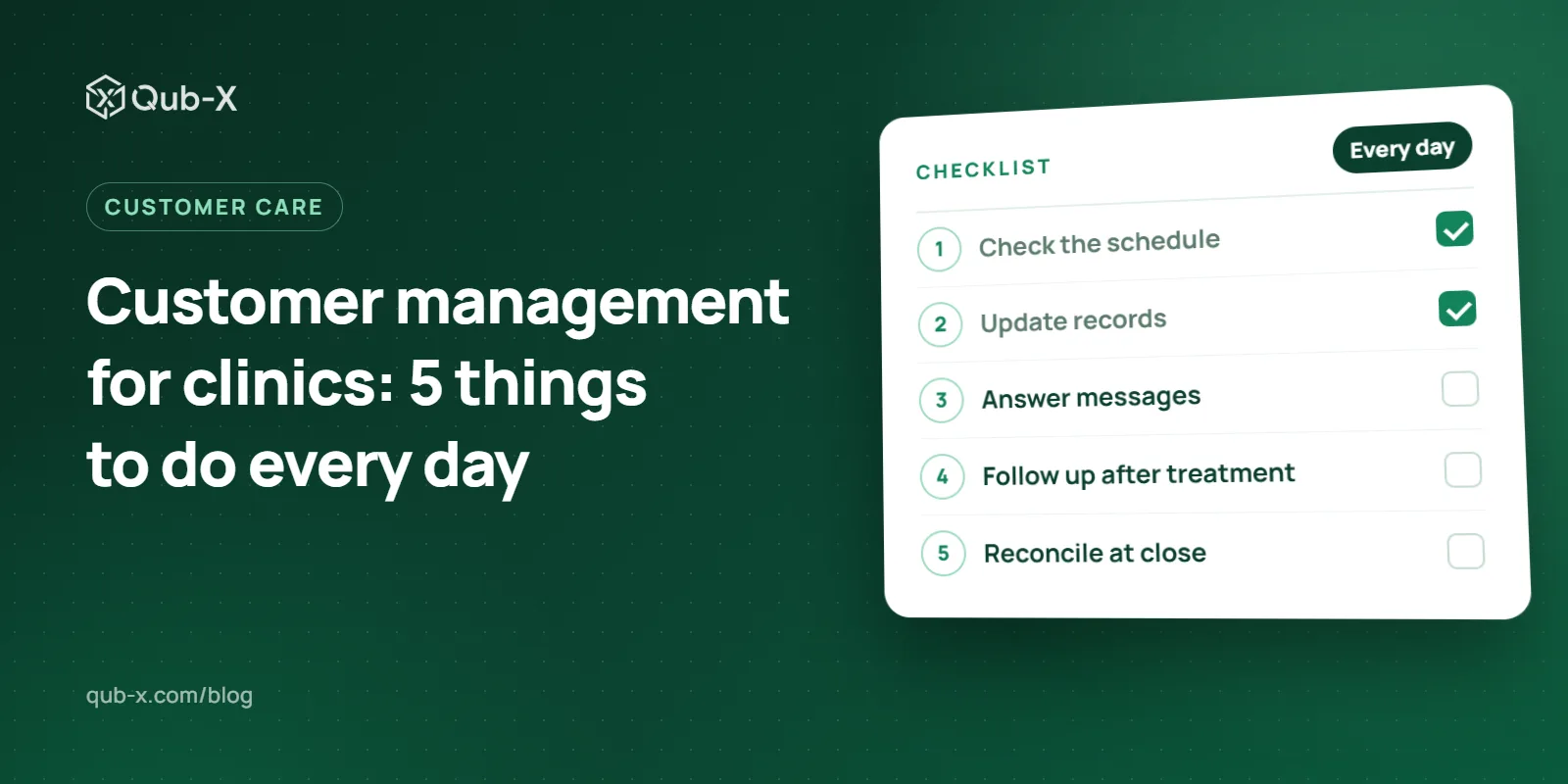
Customer management for clinics: 5 things to do every day
Customer management in a clinic is not one big project but five small tasks repeated every day. This article covers each task, who does it and when, what information to keep and the three numbers to watch.
In this article · 8 sections
Customer management in a clinic is five tasks repeated every day: check the schedule in the morning, update the record after each session, answer messages, follow up after treatment and reconcile at close. Do these five consistently and no client slips through, whether the clinic runs on a notebook or on software.
Updated 28 November 2026.
Quick summary
Five daily tasks, each with one person responsible.
A client record needs six groups of information; health information is sensitive data.
Measure with three numbers: return rate, no-show rate and first-reply time.
What does customer management in a clinic involve?
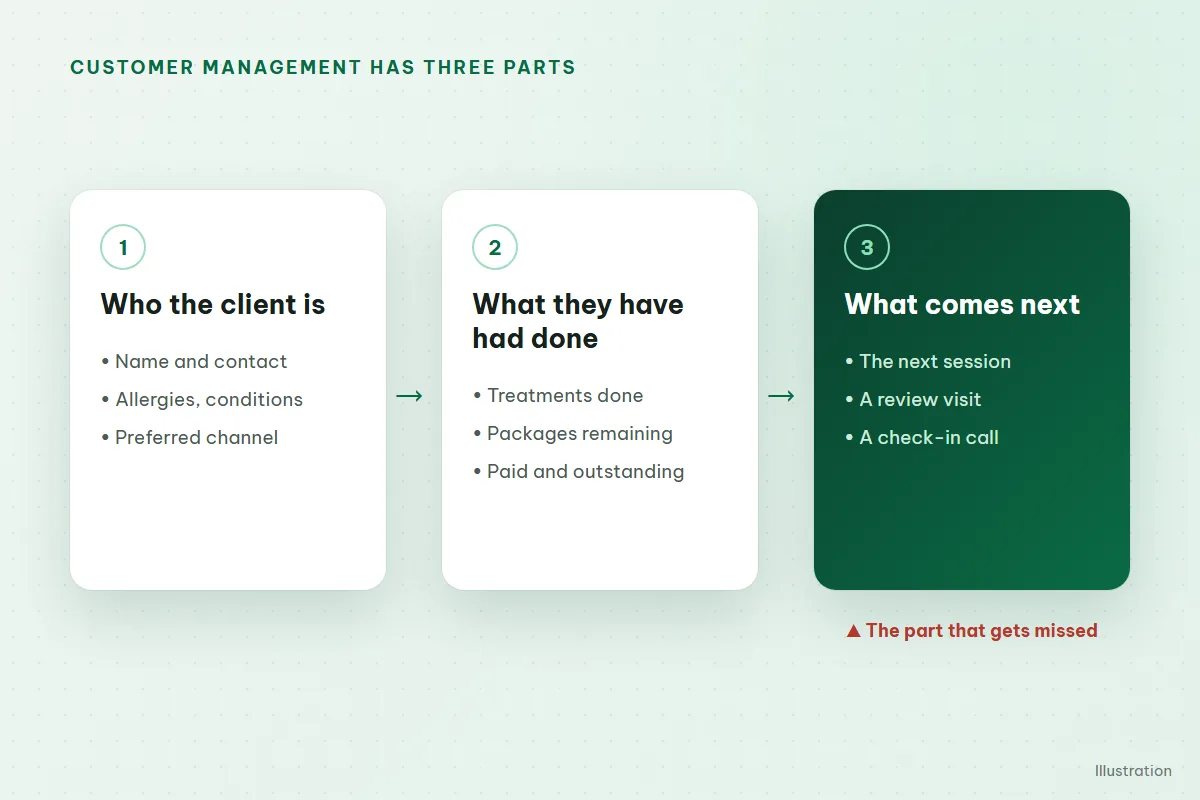
Customer management in a clinic has three parts: knowing who the client is, knowing what they have had done, and knowing the next thing to do for them. In a shop, the third part is usually the next sale. In a clinic, it is the next session of a course, a review visit or a check-in call.
When information is scattered across notebooks, spreadsheets and personal phones, the third part is the first to fail: nobody knows which client is due a call. If you are not sure what this kind of software includes, see CRM for aesthetic clinics.
What are the 5 daily customer management tasks?
These five tasks cover a working day. The table shows when and who.
Task | When | Who |
|---|---|---|
1. Check the schedule and the records of clients due in | Start of day | Reception |
2. Update the record after each session | Right after the session | Doctor, therapist |
3. Answer messages | During the day | Reception, consultants |
4. Follow up after treatment | Mid-afternoon | Care staff |
5. Reconcile | Before closing | Manager |
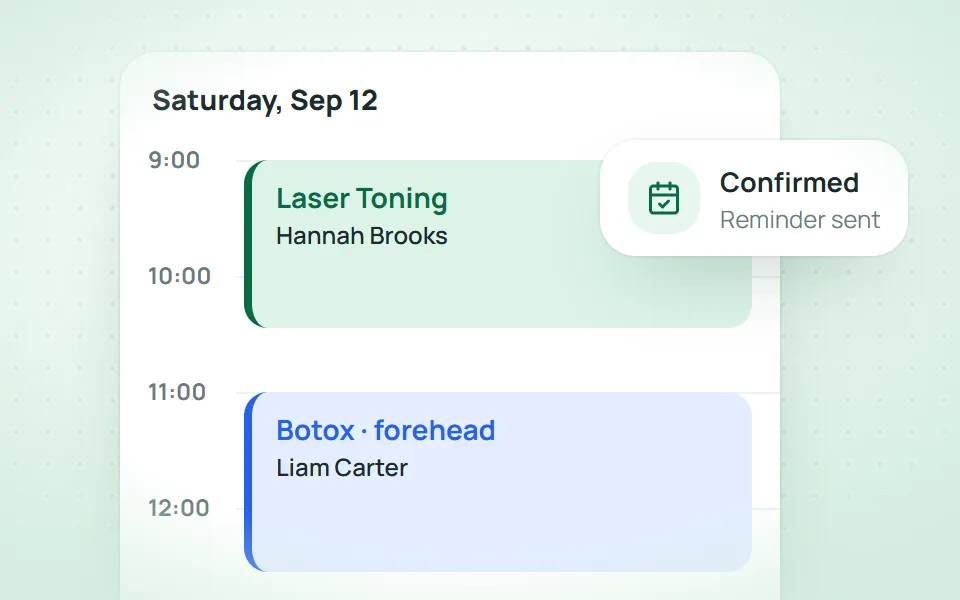
Task 1, check the schedule. Reception opens today's schedule, sees who has not confirmed and messages them. For clients due in, read the notes and allergies in advance.
Task 2: update the record right after each session
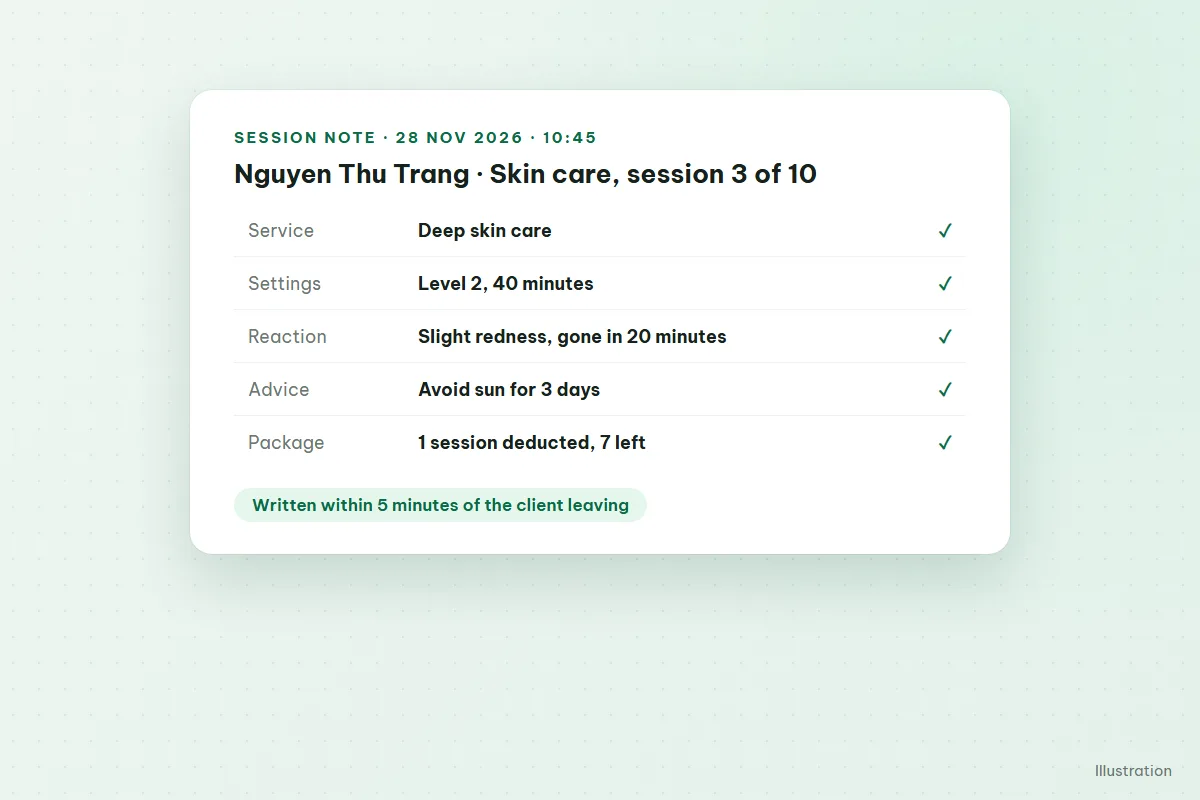
Write it down as the client leaves: the service performed, settings, skin reaction, aftercare advice. Leave it until the evening and details are lost. The session should also be deducted from the package at this point.
Task 3: answer messages during the day
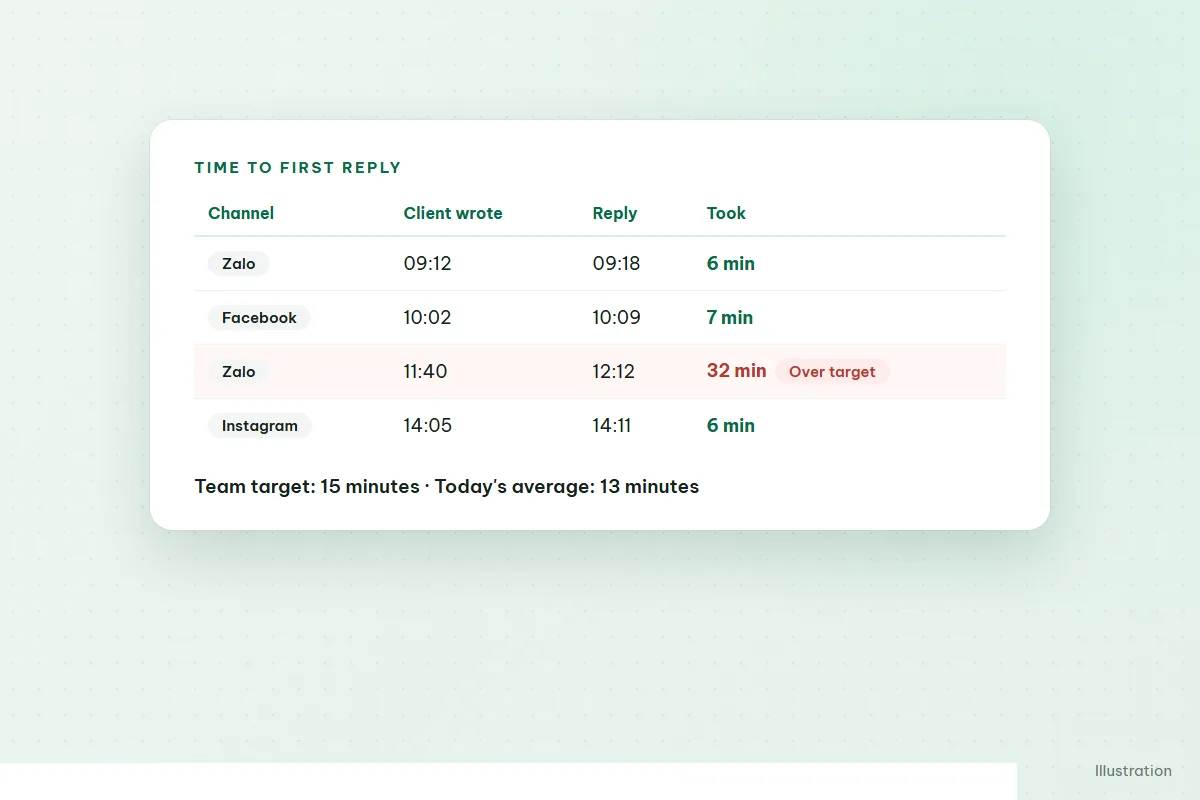
Set one target for the team, for example a reply within 15 minutes during opening hours. Messages from every channel should land in one place so the next shift can see what the previous one answered.
Task 4: follow up after treatment
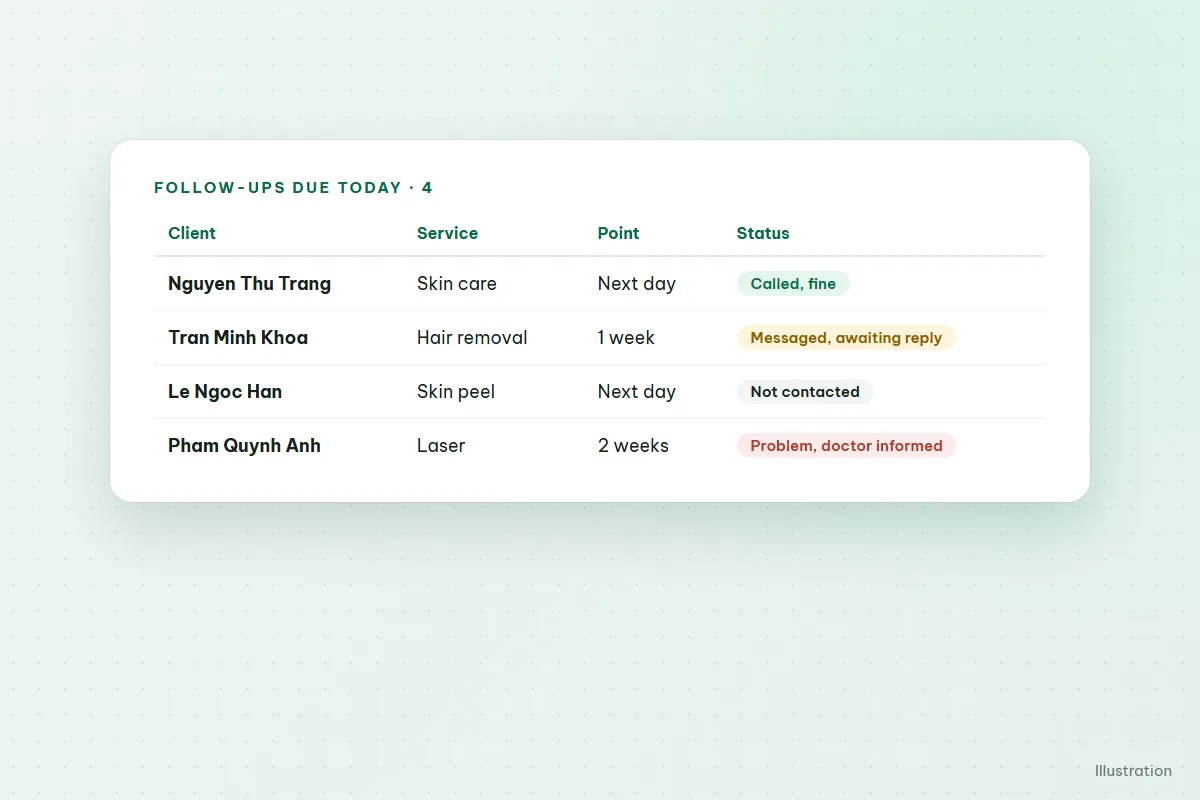
Each service has its own follow-up points. Staff open the list of clients due today and contact each one. Message templates are in our post-treatment customer care process.
Task 5: reconcile at close
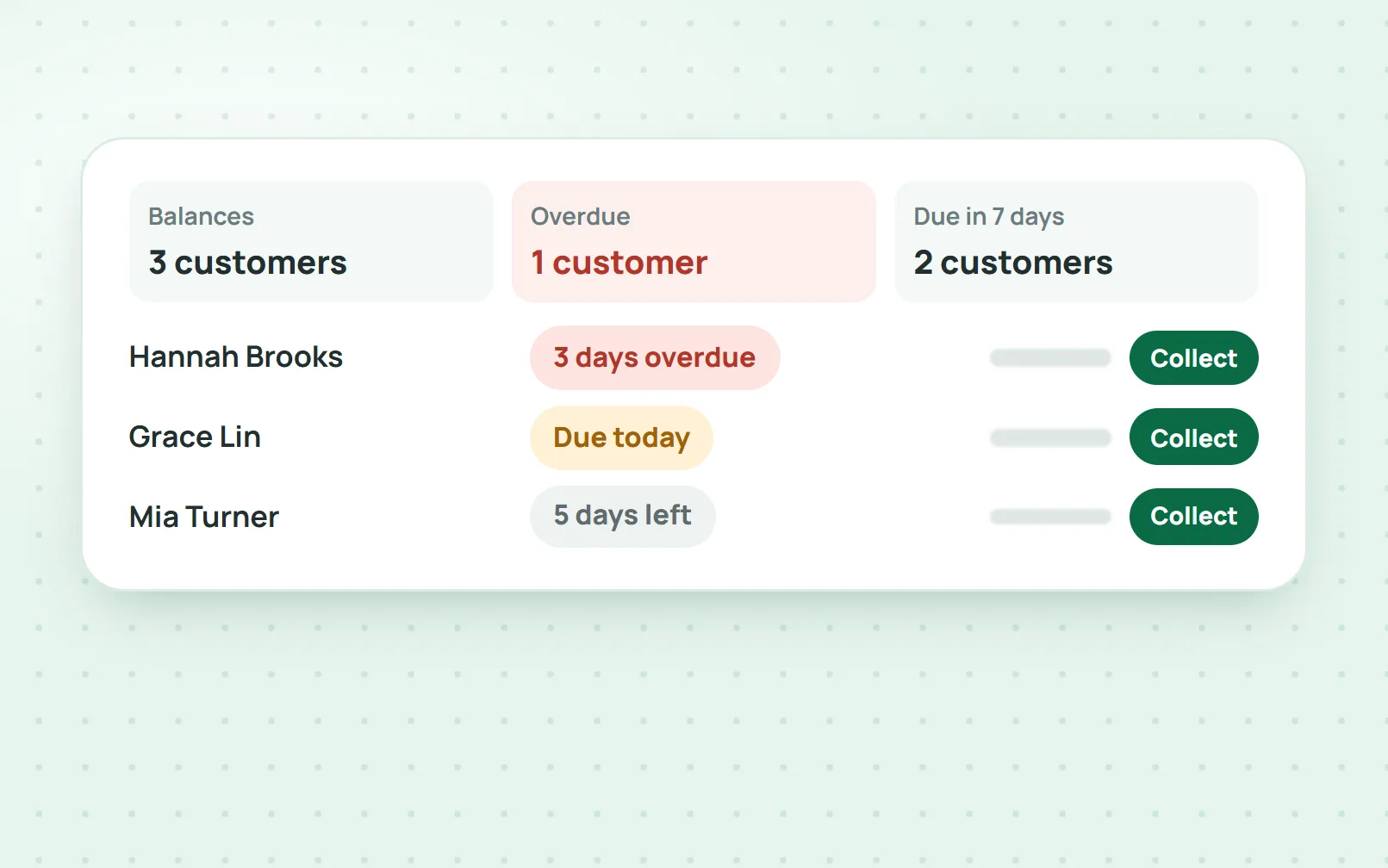
Before closing, the manager reviews three lists: clients treated today with no next appointment, clients who did not show, and clients with a balance owing. Each list goes to one person to handle the next morning.
What information should a customer management system keep?
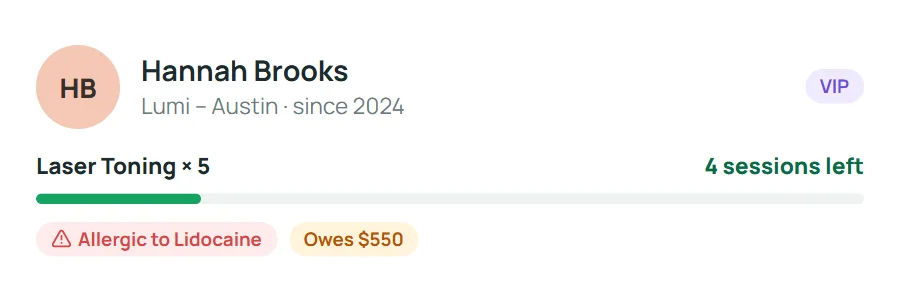
A customer management system for a clinic should keep six groups of information:
Group | Examples |
|---|---|
Contact | Name, phone number, preferred channel |
Health | Allergies, conditions, current medication |
Services | Treatments done, packages remaining |
Images | Before and after photos, consent forms |
Money | Paid, outstanding |
Care | Most recent contact, feedback |
Health information is sensitive personal data under Vietnam's Law on Personal Data Protection No. 91/2025/QH15: it needs the client's consent and restricted access. For how long medical records must be kept, see Circular 33/2025/TT-BYT. This article is not legal advice.
In Qub-X, these six groups sit in the customer record.
Who in the clinic is responsible for what?
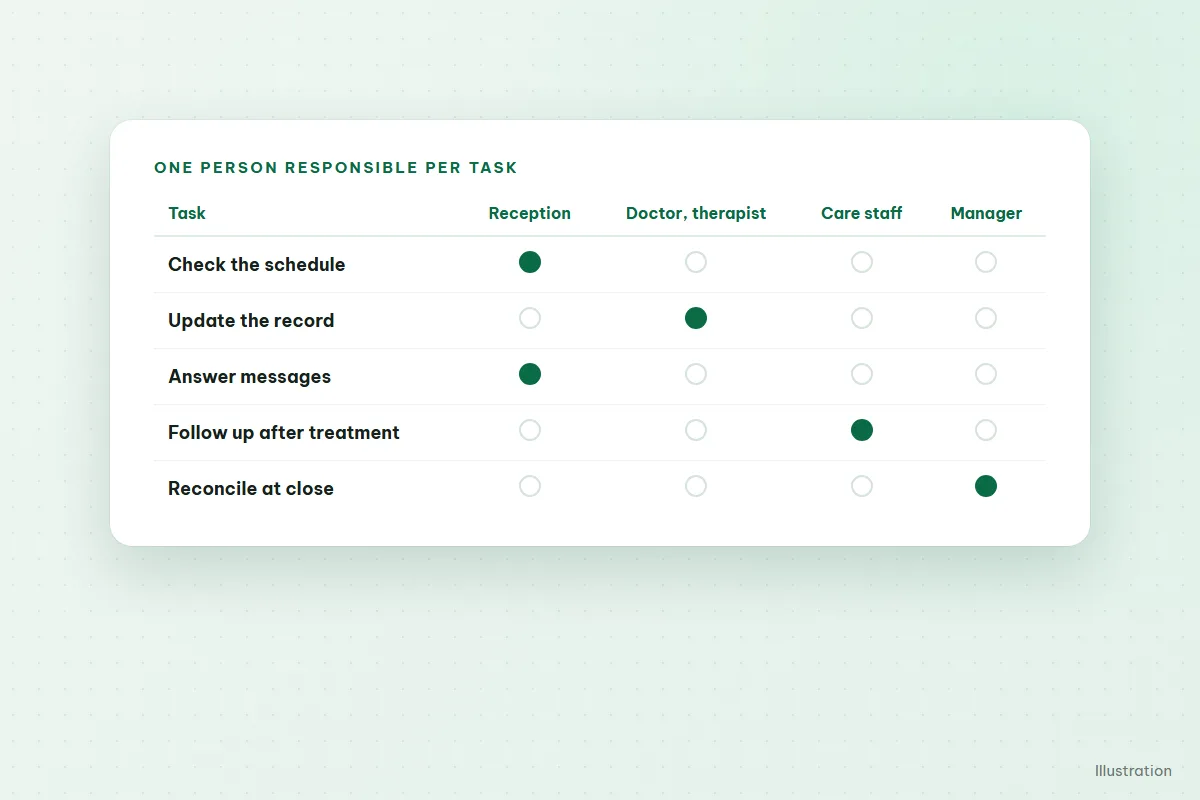
Each task needs exactly one person responsible; a task that belongs to "the team" tends to be done by nobody. A suggestion for a clinic of 5–15 people:
Reception: appointments, confirmations, messages.
Doctors and therapists: clinical notes after each session.
Care staff: follow-ups, logging feedback.
Manager: reconciling at close, the weekly numbers.
Access follows the role: reception does not need medical records, therapists do not need revenue. How to group clients for different levels of care is covered in customer segmentation in a CRM.
Which numbers show whether customer management is working?
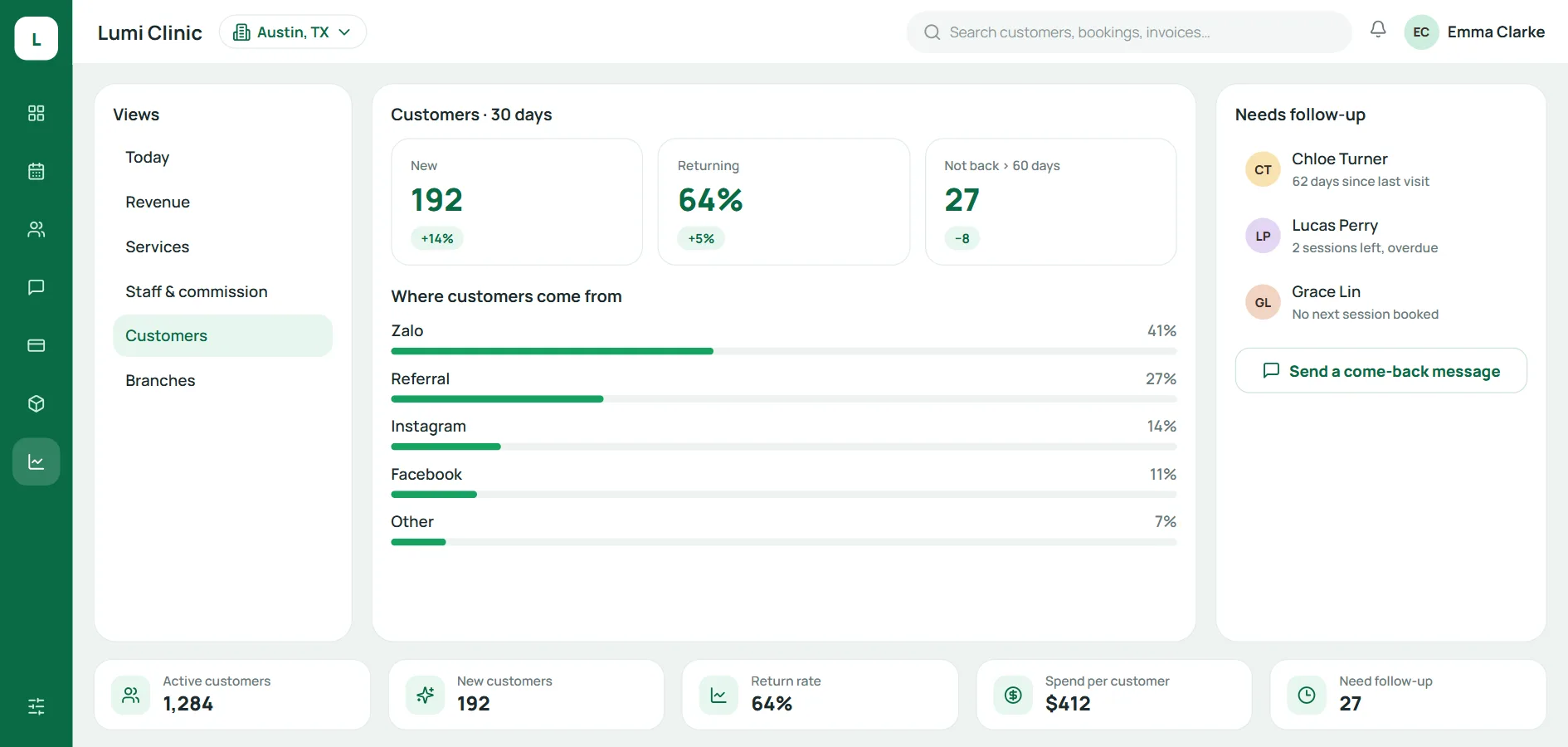
Three numbers are enough to tell whether customer management is running:
Return rate: clients on their second visit or later, divided by all clients in the period.
No-show rate: appointments where the client did not come, divided by all appointments.
First-reply time: the average during opening hours.
A hypothetical example: 400 appointments in a month and 28 no-shows give a no-show rate of 28 / 400 = 7%. Look at these three numbers every Monday; when one gets worse, go back to the matching task. For a deeper read, see how to measure CRM effectiveness.
Frequently asked questions
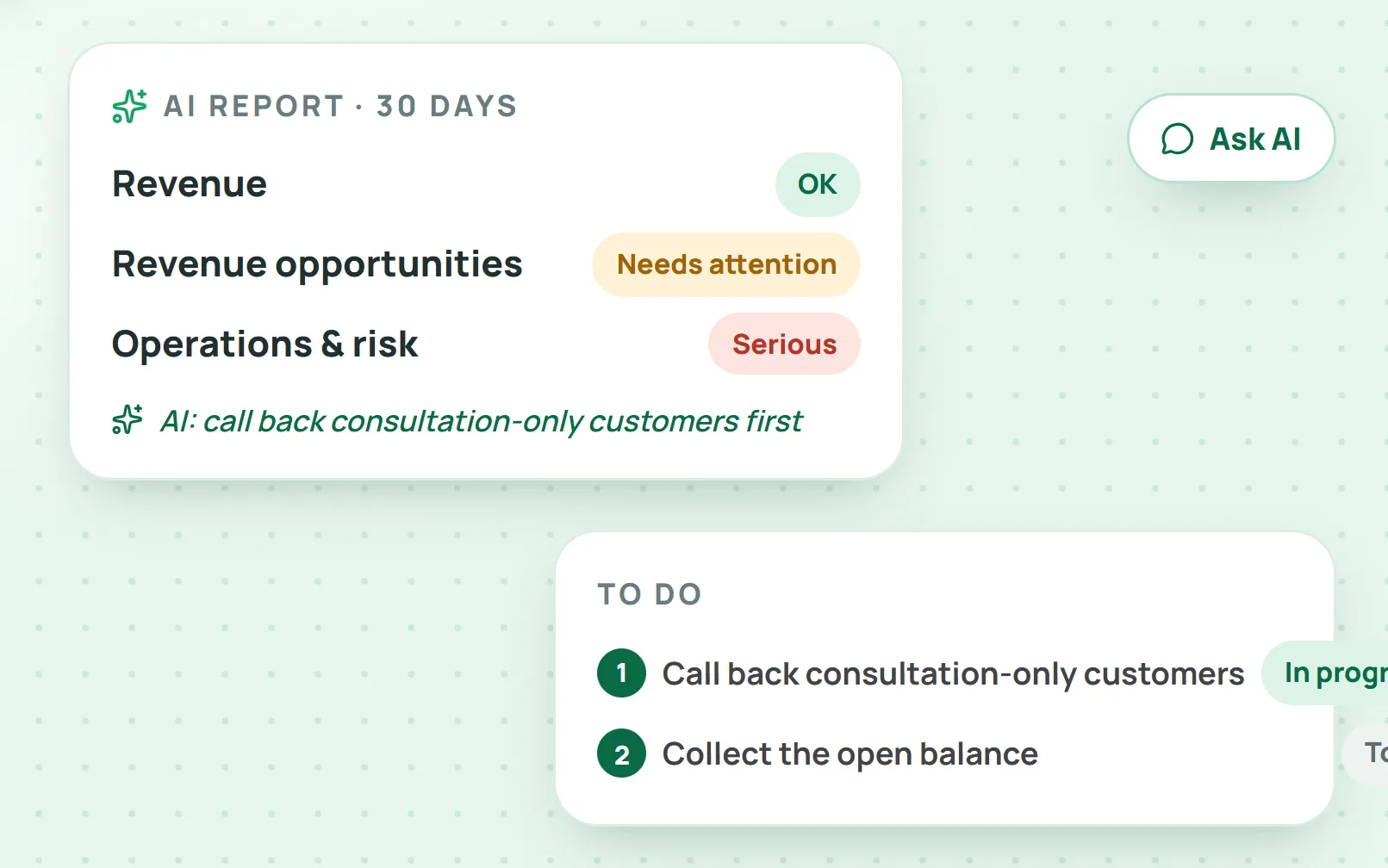
Can a clinic do customer management in a spreadsheet? Yes, with a few hundred clients and one receptionist. A spreadsheet does not prompt tasks, does not control access by role and is easily overwritten when several people edit it.
What should software for storing client information include? A record per client, appointments linked to the record, automatic task prompts, role-based access and an activity log. Clinics that treat patients also need medical records.
How long does it take for the five tasks to become routine? It depends on the clinic. The routine forms faster when each task has one person responsible and the manager reviews the end-of-day lists consistently.
Conclusion
Customer management in a clinic is five small tasks done consistently: check the schedule, update records, answer messages, follow up, reconcile. Give each task to one person, keep the six groups of information and review three numbers a week. To see these five tasks running in Qub-X, book a free demo; it takes about 10 minutes on Google Meet.
Sources
Law on Personal Data Protection No. 91/2025/QH15, Official Gazette of Vietnam (in Vietnamese).
Circular 33/2025/TT-BYT on retention periods for health-sector records, Government Portal (in Vietnamese).
Related articles
All articles on Customer care- Customer care
What is customer care software? How clinics use it
Customer care software keeps each client's information in one place and reminds staff what to do next for that client. This article explains how it differs from a CRM, the five jobs clinics use it for, and what to watch for with health data in Vietnam.
- Customer care
How to Store Before and After Photos of Clients: 5 Rules
Store before-and-after photos inside the client record, tag them to each session, shoot to one standard and get the client's consent. Includes a 5-rule table and a photo guide.
- Customer care
Post-Treatment Customer Care Process: 6 Steps and Sample Messages
A post-treatment customer care process for aesthetic clinics: 6 steps on a clear timeline, with a sample message for each step and tips for making the process run on its own.