
Post-Treatment Customer Care Process: 6 Steps and Sample Messages
A post-treatment customer care process for aesthetic clinics: 6 steps on a clear timeline, with a sample message for each step and tips for making the process run on its own.
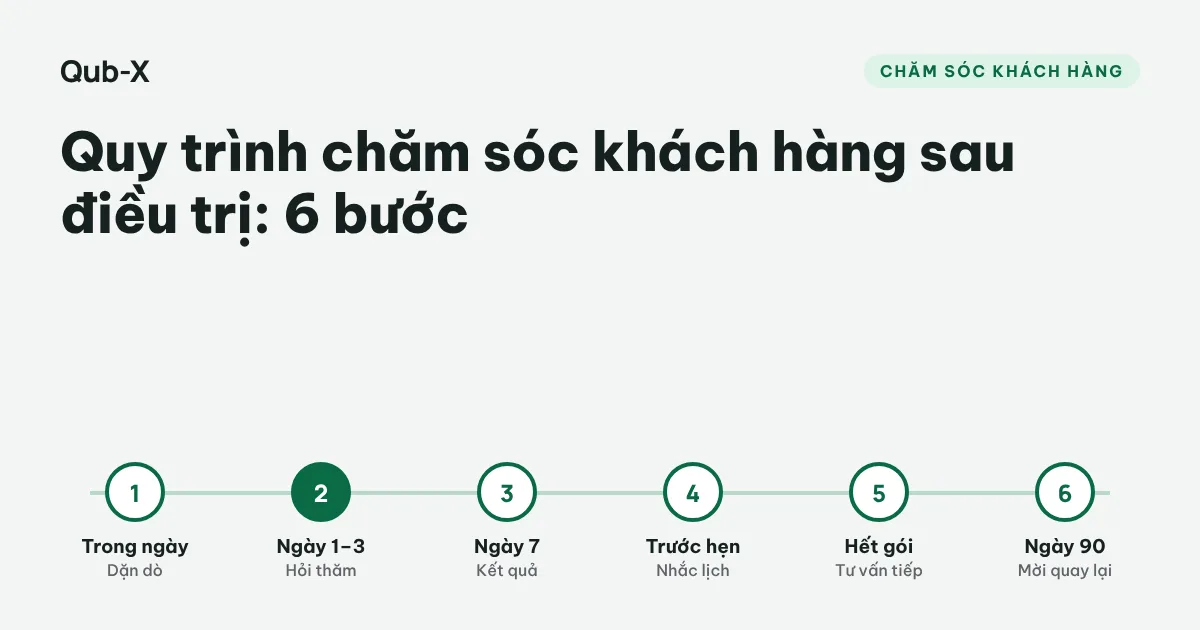
A post-treatment customer care process is the series of things an aesthetic clinic does from the moment a client leaves the treatment chair until they come back: aftercare instructions, check-ins, appointment reminders and follow-up advice. Most clinics do the first part well, then go quiet until they have a promotion to send. This article gives you a 6-step process built around a timeline, with a sample message for each step your receptionists can use right away.
Quick summary: the post-treatment customer care process has 6 steps: aftercare instructions on the day, a check-in after 1 to 3 days, a results check after 7 days, a reminder before the next session, follow-up advice when the package ends, and an invitation to return after 90 days. Each step needs one person in charge and one message template, and should be triggered by your system rather than left to memory.
Why is aftercare more important than finding new clients?
Existing clients already trust your clinic. Inviting a past client back takes less effort than persuading someone who has never visited.
Aesthetic services need several sessions. Results only show when clients complete the full course, and they only complete it when they are reminded.
Reactions after treatment need to be caught early. A well-timed check-in lets the doctor respond in time, before the client worries on their own or writes a bad review.
What are the 6 steps of the post-treatment customer care process?
Step | Timing | Action | Who is responsible |
|---|---|---|---|
1 | On the day of treatment | Send home care instructions | Receptionist |
2 | After 1 to 3 days | Check on how the client is doing | Consultant or nurse |
3 | After 7 days | Ask about results, request feedback | Consultant |
4 | 1 day before the next session | Appointment reminder | Automatic |
5 | Final session of the package | Doctor reviews, advises on next steps | Doctor and consultant |
6 | 90 days without a return visit | Invite back for a check-up | Consultant |
The timing is a suggestion. Your clinic's doctor decides the right check-in point for each service.
Sample messages for each step
The samples below use the Vietnamese-style address of an older sister ("chị") and younger sibling ("em"). Adjust them to the way your clinic usually speaks to clients, and replace the parts in square brackets.
Step 1: Aftercare instructions on the day
Hi [Name], this is [Staff name] from [Clinic]. I'm sending you the aftercare instructions for today's [Service] session: [link or content written by the doctor]. If anything seems unusual, please message or call [Phone number] right away.
The instructions must be written and approved by the doctor. The receptionist only sends them and does not write medical advice.
Step 2: Check-in after 1 to 3 days
Hi [Name], how are you feeling after your [Service] session on [Date]? If anything is worrying you, message me and I'll ask Dr. [Doctor's name] to look at it right away.
If a client reports anything unusual, pass it to the doctor immediately, record it in their file, and do not answer on the doctor's behalf.
Step 3: Results check after 7 days
Hi [Name], it's been a week since your [Service] session. How do you feel about the results? Please share a few lines so the doctor can follow your progress more closely for the next session.
Step 4: Reminder before the next session
[Clinic] would like to remind you, [Name]: you have a [Service] appointment at [Time] on [Date] with Dr. [Doctor's name]. If you need to change the time, please message us before [Cut-off time].
Step 5: When the package ends
Do this step in person at the clinic, not by message. The doctor compares before and after records, explains the results achieved and suggests the next step if needed. The consultant only talks about a new package after the doctor has made the assessment.
Step 6: Invitation to return after 90 days
Hi [Name], it's been a while since we saw you at [Clinic]. It's been about three months since your [Service] session. Would you like to come in so Dr. [Doctor's name] can check in on you? Let me know which day this week suits you and I'll hold a slot.
How do you make the process run on its own without relying on memory?
Attach a care schedule to each service. Every service has its own series of milestones. When the receptionist records a treatment session, the tasks for steps 2, 3 and 6 are created automatically with due dates.
Give staff a list every morning. The consultant opens it and sees who needs a check-in today, without digging through files.
Send reminders automatically. Step 4 is the most repeated, so let the system handle it.
Record the feedback. Whatever the client replies, write it in their file so that whoever looks after them next still knows.
Grouping clients so you know who is at which step is covered in the article on customer segmentation in CRM. For handling messages from several channels, see the article on the multichannel inbox.
4 common mistakes in post-treatment client care
Only messaging when there is a promotion, so clients treat every message from the clinic as advertising
Using one template for every service, without mentioning the service and the doctor by name
Staff answering medical questions themselves instead of passing them to the doctor
Messaging from staff members' personal Zalo accounts, so the whole chat history is lost when they leave
Which metrics measure the care process?
The share of clients checked in on time at step 2.
The share of clients who show up on time for the next session.
The share of clients who return after the invitation at step 6.
How to track these metrics each quarter is covered in the article on measuring CRM effectiveness.
TIP: Start with your best-selling service. Write all 6 steps and the message templates just for that service, run it for a month, adjust based on client feedback, and only then roll it out to other services.
Conclusion
A post-treatment customer care process doesn't need to be long, it needs to be consistent. Six milestones, each with one task and one person in charge, are enough for clients to feel followed up on rather than just sold to. You can try Qub-X free for 7 days to set up a care schedule for one of your services.
Frequently asked questions
Should you follow up with clients by Zalo, SMS or phone call?
Use the channel the client already used to book. Check-ins and reminders by message are enough, while the invitation to return after 90 days and handling complaints are better done by phone.
How many messages before clients feel bothered?
The six milestones in this article are spread over three months, so they are not dense. What annoys clients is a message that is irrelevant to them, not the number of messages.
Which step can a small-staff clinic skip?
Keep step 2 and step 4. The post-treatment check-in and the appointment reminder are the two actions with the clearest impact on whether clients come back.
Related articles
All articles on Customer care- Customer care
Aesthetic clinic CRM vs a regular CRM: 7 differences
Many clinics try a sales CRM and find it does not fit: no packages, no allergy field, no Zalo. This guide compares an aesthetic clinic CRM with a regular CRM on 7 points, so you can tell which one your clinic needs.
- Customer care
Customer Segmentation in a CRM: 5 Groups and How to Look After Each One
Sorting clients into 5 groups along their journey tells your aesthetic clinic who to contact today. Includes grouping rules, what to do for each group, and 3 metrics to track results.
- Customer care
Staff Not Using the CRM After You Bought It? 7 Reasons and How to Fix Them
Staff not using your CRM is usually a rollout problem, not a software problem. Here are 7 common reasons in aesthetic clinics, the warning signs, and a 30-day plan to get the whole team on board.