
Spa customer retention: 8 ways to bring clients back a second time
New clients take effort to find; returning clients are what build lasting revenue. Here is how to measure your return rate, a 30-day aftercare schedule and 8 things your spa should start doing now.
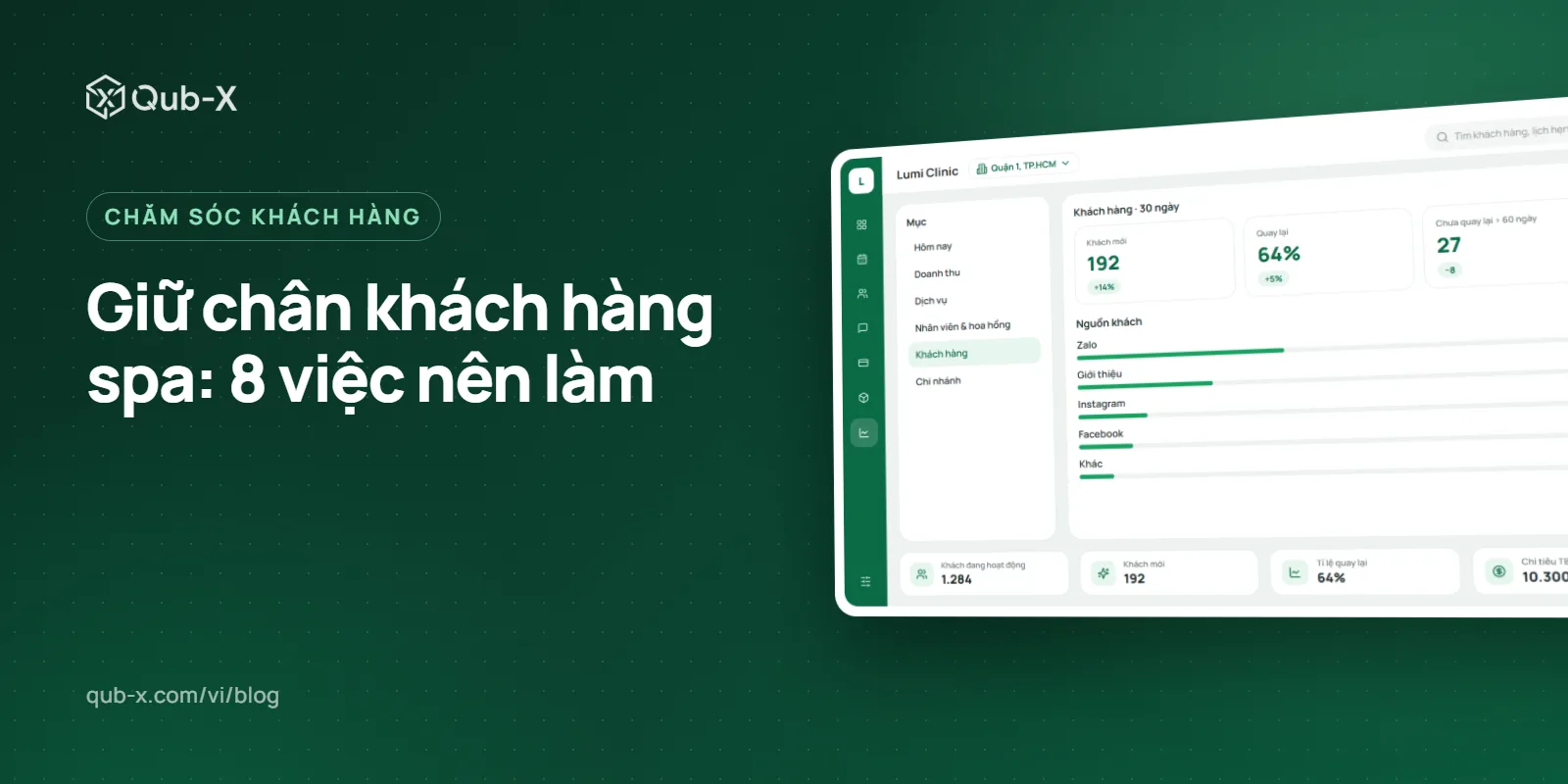
The most effective approach to spa customer retention is to get three moments right: when a client leaves the front desk after their first visit (book the next appointment there and then), one to two days after the service (check in and share home-care instructions), and when the client is nearly due to come back (send a reminder at the right time). This guide shows you how to measure your return rate, the 8 things that bring clients back for a second visit, a 30-day aftercare schedule and a call script for clients who have not been back in a while.
Why is keeping clients more important than finding new ones?
Every new client who walks into a spa is usually the result of advertising, a first-visit promotion and hours of consultation. If that client comes once and never returns, most of that effort is never recovered. A returning client, on the other hand, already understands your services, trusts your therapists and needs far less consultation time.
Returning clients are also the source of things a spa can hardly buy with advertising: long-term treatment packages, referrals to friends and good online reviews. That is why the return rate is one of the clearest indicators of the quality of a spa's service and aftercare.
It helps to think about when the cost is paid. The advertising, the introductory offer and the consultant's time are all paid for before the first service even begins. The second visit is where that investment starts to pay off, and it is also an easy visit to lose, because the client has not yet built a habit or a relationship with your team.
How do you measure your return rate?
The return rate is the percentage of clients who visited during a base period and came back at least once more within the following N days.
Formula: Return rate = Clients from the base period who returned within N days ÷ Total clients in the base period × 100%.
Choose N to match the cycle of your spa's main services, for example 60 days for regular facials and 90 days for longer treatment packages. Illustrative figures, not industry averages:
Base period | Clients who visited | Returned within 60 days | Return rate |
|---|---|---|---|
April | 280 | 112 | 40% |
May | 300 | 126 | 42% |
June | 310 | 155 | 50% |
Read the table like this: of the 280 clients who visited in April, 112 came back at least once within the following 60 days. Count each client only once per base period, however many times they visited that month, so regular visitors do not inflate the result. Because every base period needs N days to play out, June's figure can only be finalized about 60 days after June ends.
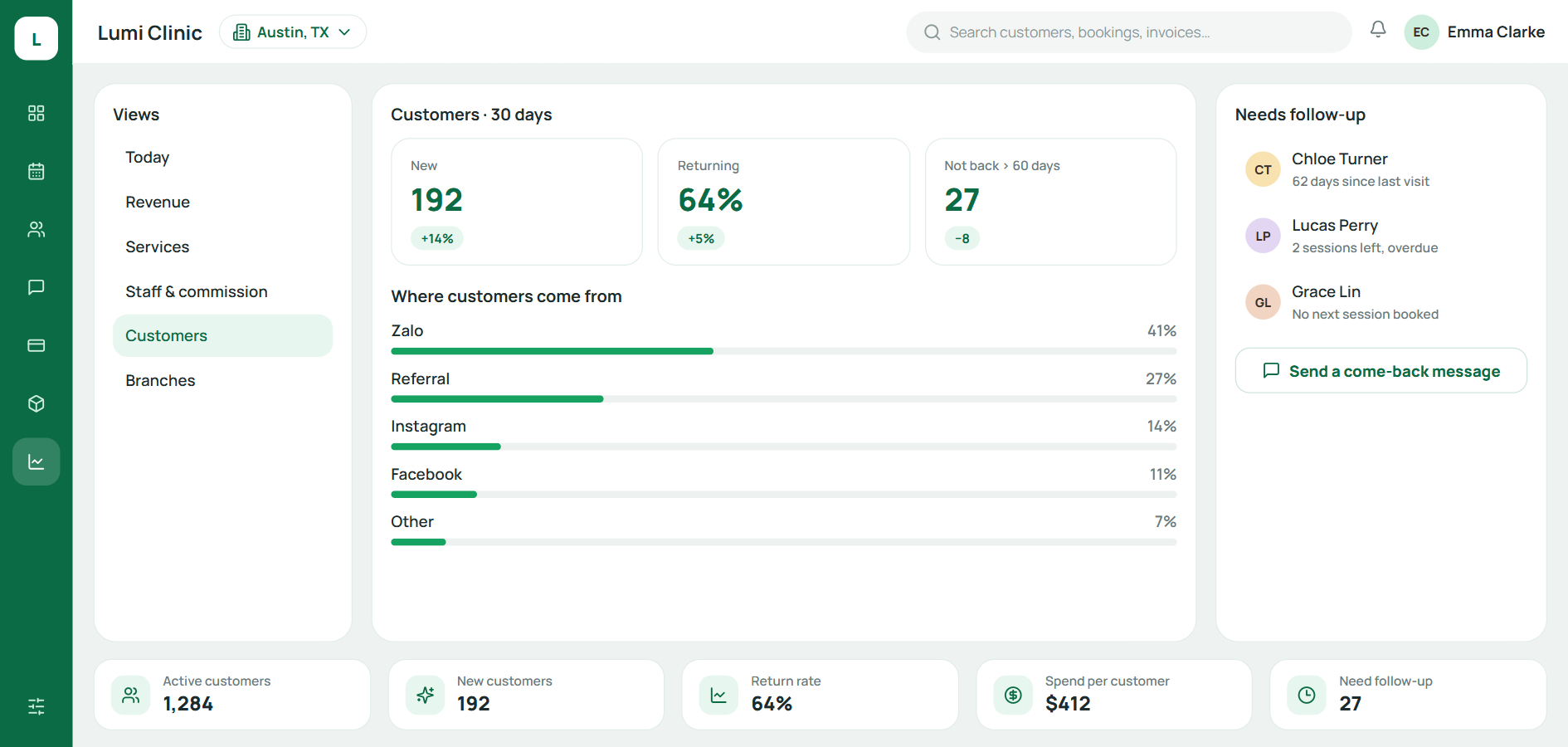
Track new and existing clients separately. New clients usually have a lower return rate, and they are exactly the group that needs the most attention. Our article on 7 key spa management KPIs explains how to set alert thresholds for this metric.
8 ways to improve spa customer retention and win the second visit
1. Record the client's needs accurately at the first consultation
Clients come back when they feel remembered. Their needs, goals, skin condition and anything they dislike should be written into their profile, not left in the consultant's head. That way, whoever serves the client next time knows what to say. See how to organize profiles in our guide to spa customer records management.
Useful details go beyond the basics: the result the client hopes to see, products that have irritated their skin before, whether they prefer to chat or rest during a treatment, and the times of day that suit them. None of this takes long to note down, yet it is exactly what makes the second visit feel personal rather than like starting from scratch.
2. Book the next appointment before the client leaves the desk
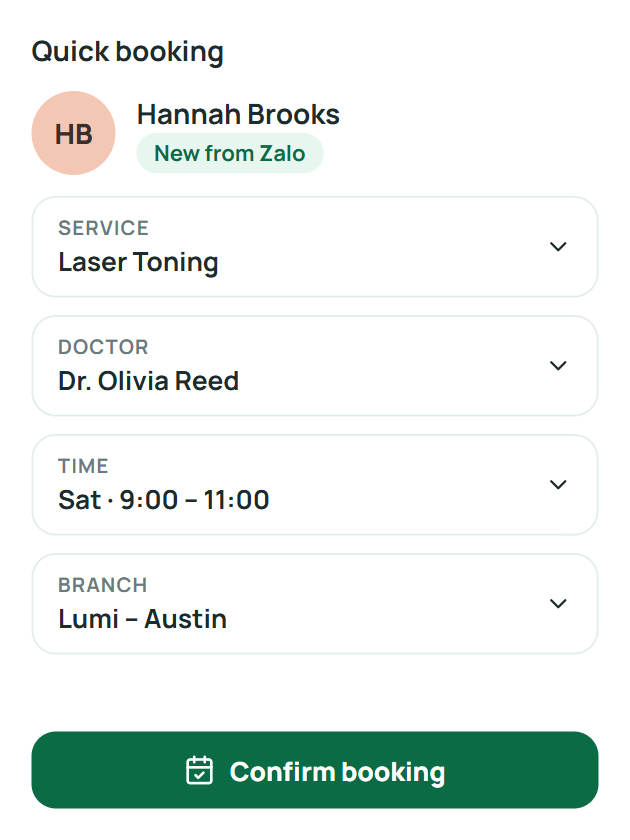
This is the simplest and most effective step of all. While a client is still pleased with the service, proposing a specific date for the next visit is far easier than sending an invitation two weeks later. If the client is not sure of their schedule, note the expected return date so you can remind them.
Make it a concrete suggestion rather than an open question. "Would you like to book again?" usually earns a polite "I'll let you know." A line such as "Your next session would be ideal around the 20th. Shall I hold Thursday afternoon for you?" gives the client an easy yes. Train the front desk to make this offer to every client, not only when the desk is quiet.
3. Check in one to two days after the service
A check-in message with home-care instructions shows the client that the spa cares about results, not just revenue. It is also the moment to catch small complaints early, before they turn into bad reviews.
Keep the message short and personal: use the client's name, mention the service they had and ask one open question, such as how their skin feels today. If the reply hints at discomfort or disappointment, pass it straight to the therapist or consultant rather than answering with a template.
4. Send reminders based on the service cycle
Every service has a right time to come back. Let your spa's specialists set the cycle for each service, then remind the client a few days before that point. A reminder at the right moment feels like care; a reminder at the wrong moment easily comes across as advertising.
Set the cycle per service instead of using one interval for everything, since a maintenance facial and a multi-session treatment package rarely follow the same rhythm. A good reminder names the service, suggests one or two time slots and makes it easy for the client to reply.
Legally, whether a message counts as advertising depends on its content, not on when it is sent: Decree 91/2020/ND-CP defines advertising messages by their content introducing products or services. Treat reminders for appointments the client has already booked, and notes on how many sessions remain, as transactional messages. Messages that invite the client back, introduce a service or offer a promotion should be treated as advertising: send them only to clients who have agreed in advance, and always give them a way to opt out, as the Advertising Law (Article 24) requires. A simple way to handle this is to ask for consent to care and promotional messages at the client's first visit, separately from any other consent.
5. Be transparent about treatment packages and prepaid cards
Clients who buy multi-session packages want to know exactly how many sessions they have used and how many remain. Sending the remaining balance after each visit prevents disputes and reminds the client to come back and use the rest.
A single line after each visit is enough, for example: "Thank you for coming in today. You have used 3 of the 10 sessions in your facial package, so 7 remain." Clients who can see their balance at any time rarely question it, and a visible balance is a gentle nudge to book the next session.
6. Give every client one owner
When everyone looks after a client, in practice no one does. Assign each client to one consultant, name a backup for when that person is away, and record every conversation in a shared profile.
Ownership does not mean the consultant does everything personally. It means one person is accountable for making sure the check-in is sent, the reminder goes out and any concern is followed through. When a consultant leaves the spa, reassign their clients before their last day, so no one discovers months later that a whole group has gone quiet.
7. Resolve complaints the same day
A complaint handled quickly and sincerely can keep a client who would otherwise have left, and shows the spa what needs fixing. Set a rule: every complaint gets a response the same day, and one person is responsible for seeing it through to the end.
Handling a complaint well usually comes down to four steps: acknowledge the problem without arguing, explain what will happen next, put it right within your policy, and follow up a few days later to check the client is satisfied. Record both the complaint and the outcome in the profile so the next person who serves the client knows the history.
8. Call clients who have not been back for a while
A client who is past their service cycle and has not returned has not necessarily left your spa. A well-handled call that checks in without pushing a sale often brings some of them back, and tells the spa the real reasons why the others do not return.
A 30-day aftercare schedule
The table below is a suggested framework for a new client after their first service. Adjust the timing to suit each of your spa's services.
When | What to do | Channel | Owner |
|---|---|---|---|
As the client leaves the desk | Book the next appointment or note the expected return date | In person | Front desk |
Same day | Say thank you and send home-care instructions | Message | Consultant |
After 1–2 days | Ask how the client feels and about early results | Message or call | Consultant |
After about 7 days | Ask about results and answer any questions | Message | Consultant |
A few days before the service cycle is due | Send a reminder and suggest time slots | Message | Consultant |
Past the cycle without returning | Call to check in and understand why | Phone call | Customer care team lead |
The schedule deliberately puts most of the work on the consultant who owns the client, so the client hears one consistent voice. The front desk takes the first step because it happens in person, and the last step goes to a team lead because a client who has lapsed is a signal worth a closer look.
This schedule only works when messages from every channel arrive in one place and each task has an owner. Our article on how a multichannel inbox reduces missed customers explains how to set that up.
A call script for clients who have not been back
The aim of the call is to understand the client, not to sell. A suggested script:
Greet and reconnect: "Hello Ms. Lan, this is Huong from the spa. I looked after you during your skin treatment course in May."
Ask about results: "How has your skin been lately? Were you happy with the results last time?"
Listen for the reason: whether the client is busy, finds the opening hours inconvenient or is not satisfied, record their exact words in the profile.
Make a gentle suggestion: only if it fits, suggest a convenient time slot or a service that suits their current condition.
Thank them and close: whether or not they book.
Keep step 4 gentle for legal reasons too. If a call is mainly to invite the client to book a service, treat it as an advertising call under Decree 91/2020/ND-CP: you then need the client's prior consent, may only call between 8:00 and 17:00, and must use a registered caller name instead of an ordinary phone number. If your spa makes calls in bulk, have a lawyer review the script.
The names in the script are only examples. At the end of each month, compile the reasons clients gave for not returning; that list is the most reliable improvement plan your spa will ever have.
Before you call, read the client's profile: the last service, who performed it, notes from earlier check-ins and any complaint that is still open. A call that opens with what the client actually had done sounds very different from a generic sales call. If the client says they are no longer interested, thank them and record the reason, so no one else calls with the same offer.
What to avoid
Bombarding clients with promotions. Clients will block your spa's channel, and you lose your aftercare channel along with it. Only message clients who have agreed to receive messages: the Advertising Law and Decree 91/2020/ND-CP both require the recipient's prior consent. The Law on Protection of Consumer Rights requires letting clients choose whether their information may be used for advertising, and the Law on Personal Data Protection requires separate consent for each purpose. Remember too that a note about their own treatment is always more welcome than a generic flyer.
Constant discounts to lure clients back. Clients learn to come back only when there is a discount, and the margin on every visit shrinks.
Leaving aftercare to memory. When a consultant is busy or leaves the job, their whole group of clients is forgotten. Put every check-in, reminder and call on a shared list with an owner and a due date.
For multi-branch chains, Qub-X is one option that automatically creates aftercare tasks with an assigned owner and tracks the return rate for each branch.
Frequently asked questions
What is a good return rate for a spa?
There is no single figure that fits every spa, because services and client bases differ. Measure your own rate over the last few months as a baseline, then improve on it step by step.
How long before a client counts as lost?
A practical rule of thumb is when a client has gone roughly twice their usual service cycle without coming back. That is the time to call and check in, rather than just sending another promotion.
Should you offer incentives to existing clients?
Yes, but tie them to the behavior you want to encourage, such as booking the next appointment at the desk or referring friends. Avoid blanket discounts for every existing client.
Should you follow up by message or by phone?
Messages suit check-ins and reminders because clients can reply when it is convenient. Calls work better when a client has a complaint or has not been back for a long time, because hearing their voice helps you understand them better.
Sources
This article summarises regulations in force as of October 2026. It is for reference only and does not replace legal advice.
Related articles
All articles on Customer care- Customer care
Multichannel inbox for spas: never miss a Zalo or Facebook message
A customer asks on Facebook, follows up on Zalo, then confirms the appointment on yet another channel. A multichannel inbox brings it all into one place, gives every conversation an owner and lets you measure response times.
- Clinic operations
Aesthetic clinic management software: 12 criteria for choosing in 2026
A licensed aesthetic or dermatology clinic should not choose software the way a spa does. 2026 brings an electronic medical record deadline, mandatory e-prescriptions and a new personal data law. Here are 12 criteria to get the choice right first time.
- Security & compliance
EMR for Aesthetic Clinics: Which Facilities Must Implement by December 31, 2026, and How to Prepare
Under Circular 13/2025/TT-BYT, aesthetic and dermatology clinics licensed to provide medical examination and treatment must complete the implementation of electronic medical records by December 31, 2026. This article summarizes which facilities are in scope, what to prepare, and how Qub-X is building its EMR feature.